


What the ankh is: origins and core meaning
The ankh is best understood as an ancient Egyptian hieroglyph that was conventionally read as life or eternal life and often appears in funerary and temple contexts; this reading and use are the foundation for later interpretations and for why the symbol persists in jewelry and art Encyclopaedia Britannica.
See provenance and restorations on @auroraantiqua
This article includes curated condition and provenance notes to help readers assess ankh motifs and related listings.
The visual form, a looped handle atop a vertical shaft, is commonly seen in tomb reliefs, wearable amulets and temple iconography where it functions as a symbolic sign rather than a literal object. Museum catalogues and object records are the primary evidence for these uses, and they show the ankh across many Pharaonic periods British Museum.
For anyone encountering the ankh in a modern market listing, it helps to start by placing that motif in its original context: hieroglyph, emblem of life, and common funerary device. That historical baseline frames how we read claims about religious use or continuity in later periods.
How the ankh functioned in ancient Egyptian religion and iconography
In ancient Egyptian religious imagery the ankh frequently appears being held by gods and conveyed to pharaohs, a visual shorthand linking rulership and divine life in cult and funerary scenes; this pattern is well documented in museum object records and curatorial descriptions British Museum.
Scholars and curators commonly interpret those pairings as symbolic of life, rebirth and the afterlife, where the ankh plays a role within broader mortuary and cultic visual programs rather than serving as a single doctrinal statement The Metropolitan Museum of Art.
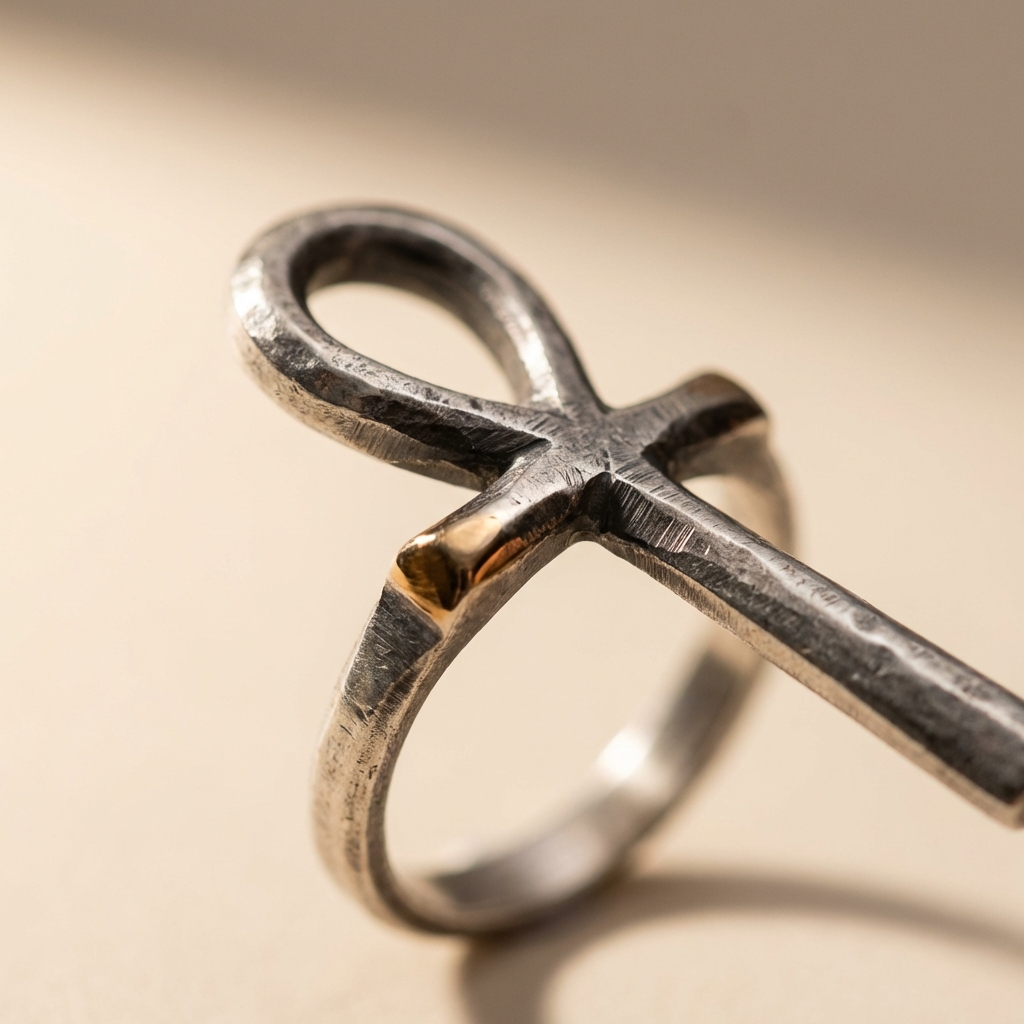
Because meaning is often contextual, museum descriptions typically link specific objects to their find contexts, associated inscriptions or accompanying imagery. That context is what allows scholars to say the ankh relates to concepts of life and rebirth rather than to offer a single, uniform liturgical function.
Late antiquity and Coptic continuity: the ankh and early Christian forms
In late antiquity, as Christianity spread in Egypt, artisans and communities sometimes reworked or reinterpreted familiar visual types, producing looped cross shapes that bear a family resemblance to the older ankh form; scholarship frames this as visual continuity and reinterpretation rather than a direct one to one transfer of meaning Oxford Research Encyclopedias and Ankh.
Some Coptic pendants and crosses show looped elements that can indicate continuity of local workshop practices and iconographic habits, but precise chronological and regional mapping of that change remains an active area of research and cannot be blanketly asserted across all finds Encyclopaedia Britannica and Coptic History.
The ankh is an ancient Egyptian hieroglyph and symbol associated with life and rebirth; while late antique Coptic art shows visual continuity in some looped forms, the ankh is primarily rooted in ancient Egyptian religious contexts.
When reading claims that equate the ankh directly with later Christian crosses, it is useful to distinguish visual similarity from documented liturgical continuity. Museums and academic surveys note resemblance in form while also pointing to separate meanings and uses in Christian ritual settings.
The ankh today: fashion, neo spiritual use and cultural appropriation
From the 20th century into the present the ankh has become a widely adopted emblem in fashion, neo spiritual practices and popular culture, often serving as a broadly recognized Egyptian motif rather than an active part of liturgical practice Journal of Contemporary Religion and Black Theology Papers Project.
Discussion in cultural studies has pointed out instances of appropriation and changing meanings when the ankh is used outside its original contexts. That critical perspective encourages buyers and collectors to be attentive to provenance and to recognize modern aesthetic uses as distinct from ancient ritual uses Gemological Institute of America.
For someone wearing an ankh motif today, the sign most often functions as a symbolic nod to Egyptian culture, an aesthetic choice, or a personal spiritual symbol, all of which are legitimate but separate from the ankh's historic role in Egyptian religion.
How to tell ancient from modern ankh jewelry: a practical checklist for buyers
Begin with a thorough visual review of the listing. High resolution photos showing front, side and back, closeups of the loop and shaft junction, and detailed views of any hallmarks are basic requirements for any credible silver ankh listing Gemological Institute of America.
Look for wear consistent with age, a natural patina in recessed areas, and manufacturing cues such as tool marks or casting evidence that match known periods; archaeological and museum entries provide useful comparanda when a listing claims historic origin The Metropolitan Museum of Art.
When the item is described specifically as a sterling silver ankh ring, request clear photos of any hallmarks and, where possible, assay or test reports. These documentary and photographic details are the first line of verification for collectors evaluating age and metal content Gemological Institute of America. You can also review similar items in our rings collection.

Provenance statements, prior collection history and condition or restoration notes are crucial. Listings that link to museum catalogue entries or to published collection records lend credibility to historical claims; absence of such documentation does not prove forgery but does raise the need for follow up Encyclopaedia Britannica.
When the item is described specifically as a sterling silver ankh ring, request clear photos of any hallmarks and, where possible, assay or test reports. These documentary and photographic details are the first line of verification for collectors evaluating age and metal content Gemological Institute of America.
Assessing silver ankh pieces: hallmarks, metal testing and condition language
What to expect from sterling silver ankh ring markings and tests
Sellers and curators commonly cite assay marks, maker marks or tested metal reports as reliable indicators that a piece is silver and as an initial step in dating a modern piece; these marks appear differently across countries and time periods, so photographic documentation of the mark is essential Gemological Institute of America.
If a listing lacks any visible hallmark but is presented as sterling, ask for a reported metal assay or a professional test. Third party testing results, or at least a detailed seller-provided assay image, increase transparency and allow comparison with known hallmark systems.
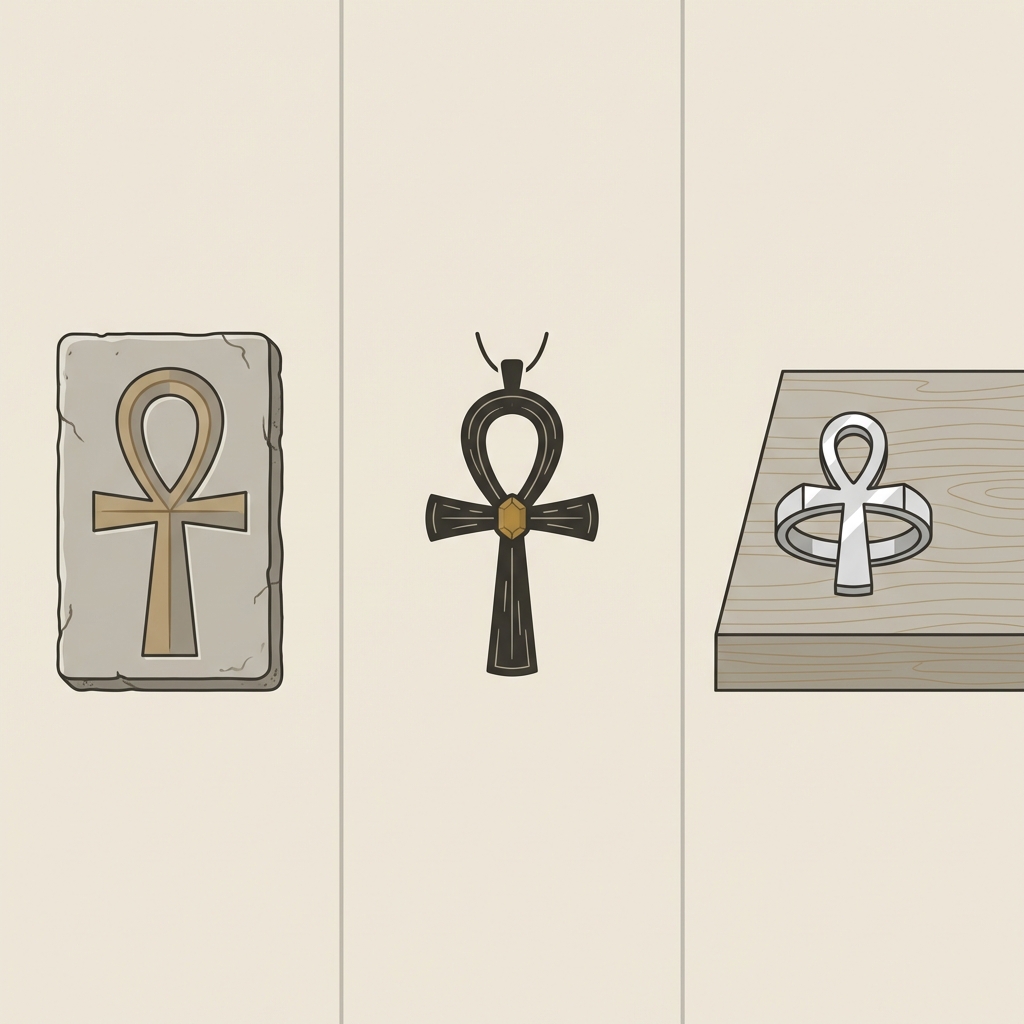
How restoration notes should be described
Clear restoration notes specify what was stabilized or repaired and what was left untouched. Descriptions that explain soldered joins, replaced fittings, or conserved patina in simple terms help a buyer understand condition while avoiding inflated claims about value or authenticity The Metropolitan Museum of Art.
When a seller mentions restoration, ask for close images of the treated area and, where relevant, a conservator's report. Reasonable restoration can make an item wearable and stable but should be described so it does not obscure original surfaces or important diagnostic features.
A collector's buying checklist and tools for verifying claims
Work through an ordered checklist: photo review, hallmark inspection, provenance request, condition and restoration queries, and finally seek museum or academic references when claims are historical. This sequence helps buyers prioritize checks and target follow up questions efficiently Gemological Institute of America.
A concise set of verification steps collectors can use when evaluating ankh listings
Start with clear images
As a practical next step, prepare short, specific questions to send to sellers: ask for provenance dates or collection names, request high magnification photos of junctions and marks, and ask whether any metal testing has been done. Short, focused requests are more likely to get useful replies. For assistance you can use the contact page to reach the seller or a specialist.
When a listing claims an object was part of a documented collection or matches a published example, ask for the exact catalogue entry or publication reference. Academic or museum corroboration remains the most persuasive support for historical claims.
Common mistakes and marketplace misrepresentations to avoid
A frequent error is reading stylistic continuity as direct liturgical continuity; similar looped shapes across periods can reflect shared workshop habits rather than identical religious meaning, and museum scholarship advises caution when making direct equivalences Oxford Research Encyclopedias.
Another common marketplace tactic is vague dating without supporting documentation. Listings that offer a broad age range but omit provenance or key photos should prompt follow up questions rather than immediate acceptance of the stated period Gemological Institute of America.
Avoid relying solely on a symbol's presence to determine age. The ankh motif is widely reproduced and reused, so the presence of the looped form is a starting point for enquiry rather than conclusive evidence of antiquity.
Conclusion: responsibly buying and wearing an ankh motif
The ankh originated as an Egyptian hieroglyph associated with life and rebirth and appears throughout Pharaonic art and amulets; later visual forms influenced Coptic looped crosses, but similarity does not automatically equal identical liturgical use Encyclopaedia Britannica.
For collectors seeking a sterling silver ankh ring or pendant, the practical checks remain consistent: request high quality photos, clear images of hallmarks, provenance statements, and transparent condition or restoration notes. When historical claims are made, ask for museum or academic references supporting those claims The Metropolitan Museum of Art.
Treat modern fashion and neo spiritual uses of the ankh as contemporary repurposings of an Egyptian motif. Wearing the symbol is a personal choice and can be done with respect for its history if accompanied by an informed approach to documentation and provenance.
The ankh is originally an Egyptian hieroglyph; some late antique Coptic forms show visual similarity but the ankh is not the same as historic Christian liturgical symbols.
Ask for high resolution photos, clear images of hallmarks or assay marks, provenance or collection history, and detailed restoration and condition notes.
Yes, many wear the ankh as an aesthetic or personal symbol, but it helps to understand its historical context and be mindful of cultural sensitivity.
References
- https://www.britannica.com/topic/ankh
- https://www.britishmuseum.org/collection/term/x10005
- https://www.metmuseum.org/art/collection/search#!/search?artist=Ancient%20Egyptian
- https://auroraantiqua.store/collections/artifacts
- https://en.wikipedia.org/wiki/Ankh
- https://oxfordre.com/religion/view/10.1093/acrefore/9780199340378.001.0001/acrefore-9780199340378-e-101
- https://researcharchive.calacademy.org/research/anthropology/coptic/Copthist.htm
- https://www.tandfonline.com/doi/full/10.1080/13537903.2024.XXXXXX
- https://journals.library.columbia.edu/index.php/btpp/Logo
- https://www.gia.edu/gia-news-research
- https://auroraantiqua.store/collections/rings
- https://auroraantiqua.store/products/authentic-medieval-crusader-silver-ring-bethlehem-star-of-bethlehem-motif-12th-13th-century-ad-us-10-eu-62-5
- https://auroraantiqua.store/pages/contact