


What the Claddagh ring is - a concise definition
Short answer
The ancient claddagh ring is a distinctive Irish ring whose canonical design pairs two hands, a heart and a crown and which is widely described in museum and reference literature as an emblem of friendship, love and loyalty, associated with the Claddagh fishing village outside Galway; this concise identity helps buyers and collectors know what to look for when comparing examples.
For a clear reference on the design and cultural meaning consult the Encyclopaedia Britannica entry on the Claddagh ring which summarises the ring's conventional elements and symbolism.
What collectors and buyers should know first
Collectors approaching an original or antique Claddagh ring should treat the ring primarily as a local cultural emblem and wearable antiquity, rather than as a single provenanced artifact with an unquestioned origin; that perspective helps set realistic expectations about condition, provenance and documentation. For further discussion see our Q&A on Irish wedding bands and related rings.
Contextual materials from local museums and reference works are the most useful starting points for learning how the ring is presented in public collections and regional histories.
Subscribe for contextual essays and catalog updates
Please sign up for Aurora Antiqua's occasional newsletter to receive contextual essays and catalog updates that explain condition notes and collection history without promising certainty about individual pieces.
Where the design comes from - local history and museum perspective
Claddagh village context
Local history places the ring's origin in the Claddagh fishing community near Galway, and that association is the prevailing description used by city and regional museums when they explain the motif to visitors.
The Galway City Museum materials give a useful, locality-centred account of the Claddagh ring's connections to community life and local makers, which is helpful for understanding the ring's cultural context.
How museums and local history present the origin
Museum descriptions and reference works typically present the ring's link to the Claddagh village as a documented tradition that informs how the design is collected and displayed, rather than as a single fully established event in art history.
When evaluating claims about origin, it is helpful to remember that museum and local history accounts are valuable interpretive records that may accept popular narratives while also noting their documentary limits.
What the symbols mean - hands, heart and crown
Symbolism in authoritative references
The three canonical elements are conventionally read as hands for friendship, a heart for love and a crown for loyalty, a symbolic reading that appears consistently in authoritative reference works and museum labels.
That conventional symbolism is recorded in reliable reference sources and is central to how the ring is interpreted in exhibitions and collecting guides.
The original Claddagh ring is defined by its canonical motifs of two hands, a heart and a crown and its cultural association with the Claddagh village near Galway; assessing age relies on hallmarks, maker's marks, consistent patina, documented provenance and, when needed, specialist analysis.
How symbolism informs collecting and display
For collectors, the symbolism helps with interpretation and display decisions but does not substitute for objective dating; symbolic motifs can be copied or revived in later periods and therefore should not be used alone to establish age.
Understanding motifs such as intaglio carved scenes or simple iconographic choices supports interpretive captions and responsible cataloguing when pieces are sold or presented in a collection.
The Richard Joyce story - popular tradition versus historical caution
The 17th-century Richard Joyce account
A widely told narrative names Richard Joyce from the Galway area as a maker associated with an early Claddagh design; that story is preserved in the National Museum of Ireland's materials as part of the ring's documented tradition.
Readers should treat the Richard Joyce account as an important part of the ring's cultural history while recognising that scholars present it as tradition rather than an incontrovertible single-source origin.
How historians treat the story
History-focused discussions emphasise caution: the Richard Joyce narrative is useful for cultural interpretation but historians recommend using a mix of documentary evidence and material study before concluding a firm provenance or precise date.
When a seller or listing relies heavily on the Joyce story to claim a specific maker or date, ask for the documentary basis and any supporting collection history before accepting the assertion.
Periods and revivals - why dating can be tricky
17th to 19th century revival patterns
The Claddagh design has seen later revival in the 18th and 19th centuries which produced many pieces that imitate or adapt the earlier motif, so a given Claddagh-style ring may come from a revival period rather than an original early example.
Because the form was revived at different times, style alone is not a reliable indicator of an original 17th-century piece.

Why style alone is not a reliable date marker
Specialist studies and collecting literature emphasise that stylistic similarity can mask chronological differences, and reliable dating generally requires hallmarks, provenance, or specialist assessment rather than appearance alone.
When assessing a suspiciously consistent style it is wise to consider the market history of revival jewellery and to prioritise documentary evidence when available.
How to spot an antique Claddagh ring - hallmarks, maker marks and construction
Using hallmarks and assay records
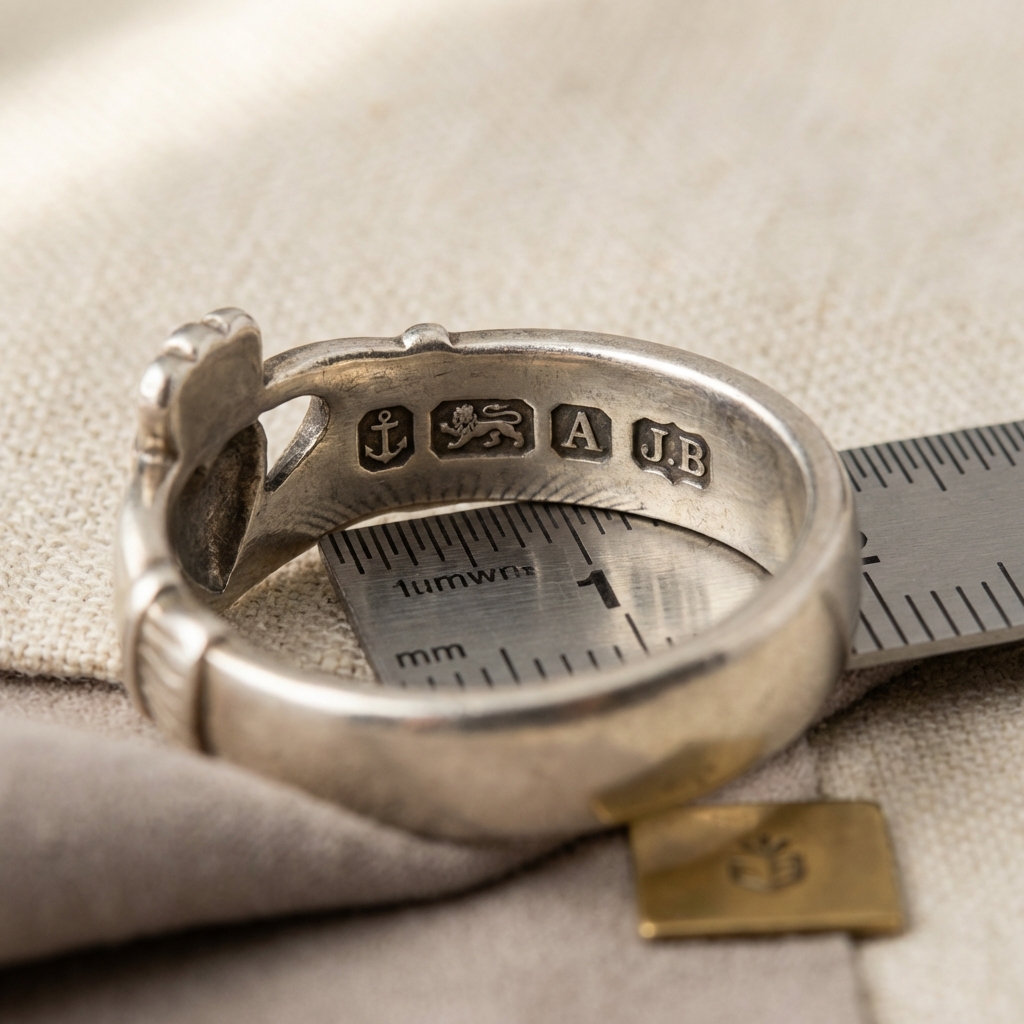
Hallmark and assay records are among the most objective tools for dating and attributing metalwork; assay offices publish guides that help collectors interpret marks and check dates when marks are legible.
When you encounter hallmarks, compare them to authoritative hallmark guides and consider contacting the relevant assay office for clarification if the mark is worn or unfamiliar. See an overview of Irish hallmarking practices from a specialist source at Claddagh Design on the Dublin Assay Office and user-focused hallmark notes at Silvermakersmarks' date marks index.
Material, construction and maker marks to check
Physical indicators include consistent materials and construction techniques appropriate to an era, maker's marks where present, and wear patterns that are non-uniform and consistent with long use rather than modern tooling.
Photographs that include close-ups of shoulders, hoop joins and any maker's marks greatly improve the ability to assess a piece remotely; when marks are absent, a specialist assessment or technical testing may be necessary.
Patina, wear and restoration notes - conservation indicators
What patina and non-uniform wear tell us
Surface patina and non-uniform wear, when consistent with long use, are practical indicators that a piece has aged in place rather than being a recent manufacture with artificially applied surface effects.
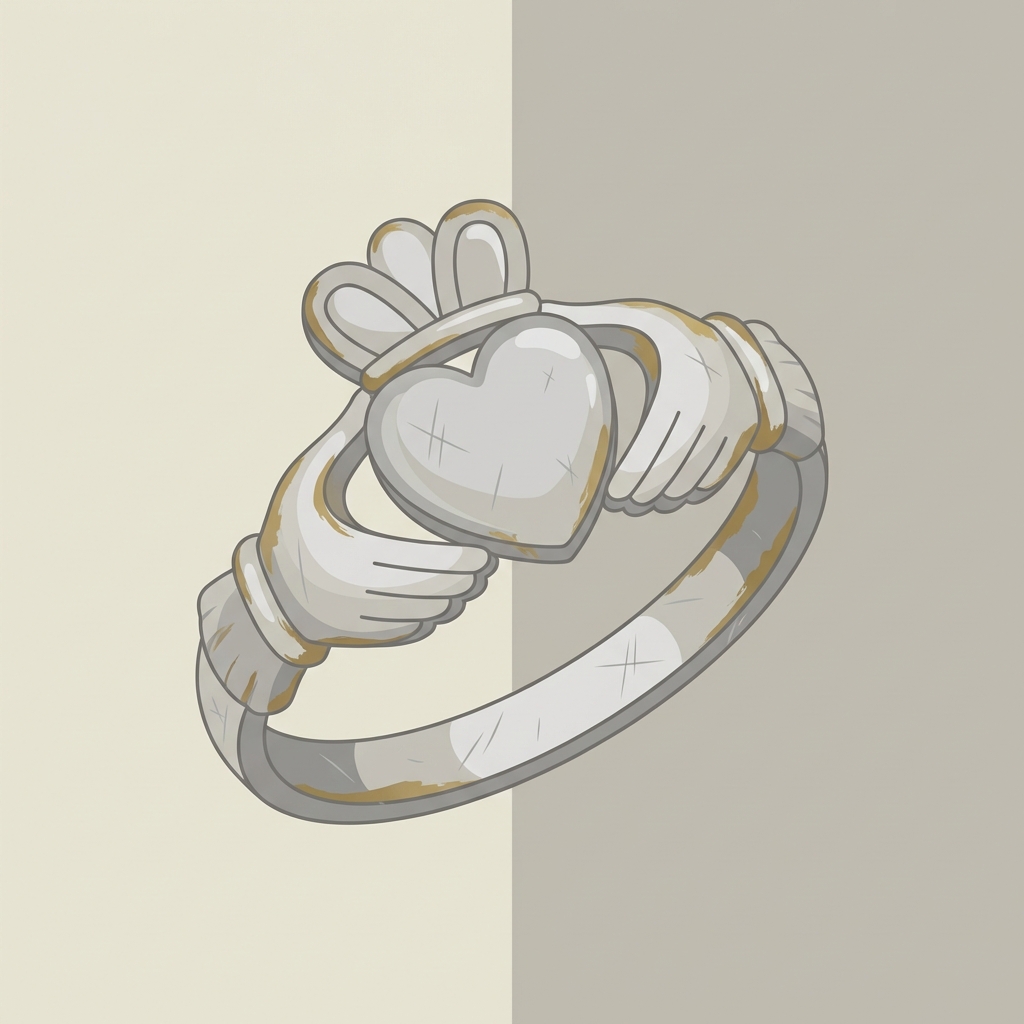
Preserving original patina is generally recommended by conservators because removing it can erase important evidence about the object's history and condition.
quick hallmark and condition checklist for first assessment
Compare marks with an official hallmark guide
How restoration notes should be read
Conservator and restoration notes should be recorded and disclosed; these notes explain what was stabilised, repaired or left untouched and are important for understanding condition and future care.
When restoration is documented, buyers can weigh the nature of interventions against their collecting goals and decide whether the piece fits their expectations of an antiquity or a restored object.
A buyer's checklist - decision criteria before you buy
Minimum documentation to request
Ask sellers for clear, well-lit photos of the ring from multiple angles, measurements, close-ups of any hallmarks or maker's marks, and any provenance or collection history that accompanies the item. You can compare listed examples with similar items in our rings collection to check presentation standards.
Condition notes and any conservator statements should be requested and read carefully as part of the listing or private sale documentation.
Red flags and reasonable expectations
Red flags include missing close-up images of marks, overly definitive dating claims without documentation, and listings that discourage independent verification; reasonable expectations include some wear consistent with age and the possibility of revival-era examples when hallmarks are absent.
If a listing lacks clear imagery or provenance, consider requesting additional documentation or stepping back until an expert assessment can be made.
Common mistakes and pitfalls collectors make
Relying on style alone
One common error is assuming a Claddagh design proves an early date; revival pieces intentionally reuse motifs and can appear convincingly old while being later productions.
Avoid making purchase decisions based purely on motif or style without corroborating mark-based or provenance-based evidence.
Ignoring assay evidence and restoration history
Another frequent mistake is overlooking hallmarks or restoration notes; hallmarks provide objective clues and restoration history explains interventions that affect condition and interpretation.
When marks are ambiguous, consult an assay office guide or a specialist before finalising a purchase. For practical examples of hallmark stamps and user guidance see an overview on Irish hallmark stamps.
Three practical examples - applying the checks in real scenarios
Example A: likely antique with hallmarks
Imagine a ring with a clear Irish or British hallmark, consistent construction techniques for silver work, and non-uniform wear with stable patina; this combination strengthens the case for an older date and suggests the next step is to obtain an expert report and provenance documentation where available.
When hallmarks are present, consult an official hallmark guide to match the symbols and date letters before relying on stylistic cues alone.
Example B: 19th-century revival without clear marks
A ring that matches known revival forms but lacks hallmarks or clear provenance should be regarded as possibly later; in such cases a specialist assessment, comparative stylistic study and technical testing can help narrow the date range.
Revival pieces are common and not inherently problematic for collecting, but they should be described accurately and not promoted as earlier works without corroborating evidence.
Example C: modern reproduction or unclear provenance
If a seller cannot supply close-up images of marks, offers inconsistent condition notes, or relies solely on a famous origin story without documentation, it is reasonable to pause and request more information or decline the purchase until the record is clarified.
When provenance gaps are significant, particularly for pieces that passed through private markets mid-20th century, specialist input can clarify whether the item merits acquisition for a collection.
Care and conservation tips for owners
Everyday handling and storage
Handle rings with clean hands, store items in stable, dry conditions away from direct sunlight, and avoid abrasive cleaning which can remove patina and surface evidence.
Use soft storage pouches or boxed compartments to reduce contact with other metal objects and to limit abrasion during storage or transport.
When to seek professional conservation
Seek professional conservation advice if a ring shows structural instability, active corrosion, or if previous repairs are in question; trained conservators can document interventions and suggest reversible treatments where appropriate.
Museum guidance on jewellery care provides practical steps for owners who want to preserve original surfaces and stabilise fragile elements.
When to consult a specialist - tests and expert reports
Signs you need professional assessment
Consult a specialist when hallmarks are missing or ambiguous, when a piece has high market value, or when provenance is incomplete and the potential historical significance requires confirmation.
Specialists can recommend material tests, microscopic assessment of tool marks, or archival research to strengthen attribution claims.
What specialists and assay offices can provide
Assay offices and qualified specialists can interpret marks, confirm metal fineness, and sometimes provide dating guidance; an expert report is valuable to record findings and to improve the documentation trail for a collection.
Keep copies of any expert reports or assay confirmations as part of an item's collection history and provenance documentation.
Conclusion - summary and next steps for collectors
Key takeaways
The Claddagh ring is best understood as a local Irish emblem from the Claddagh village near Galway defined by hands, a heart and a crown; its origin narratives are important cultural traditions but dating and attribution should rely on hallmarks, maker's marks, provenance and specialist assessment.
Prioritise objective evidence such as assay marks and documented restoration notes when considering a purchase and seek specialist help when uncertainty remains.
Where to learn more
Further reading in museum literature and hallmark guides is the practical next step for collectors seeking to deepen their knowledge and to build reliable documentation for items under consideration. You can also browse our Celtic Rings collection for comparative examples and museum-style listings.
Responsible collecting emphasises transparent condition notes, documented provenance when available, and conservator-friendly care for wearable antiquities.
Check for legible hallmarks and maker's marks, examine consistent non-uniform wear and patina, and request provenance or restoration notes; when marks are absent, seek a specialist assessment.
The Richard Joyce account is part of the ring's documented tradition recorded in museum materials but historians treat it with caution and do not consider it an incontrovertible single-source fact.
Avoid abrasive cleaning, preserve original patina where possible, and consult a conservator for structural issues; routine gentle care and proper storage are usually the best approach.
References
- https://auroraantiqua.store/blogs/questions-and-answers/what-is-an-irish-wedding-band-called-unveiling-the-claddagh-rings-significance
- https://auroraantiqua.store/collections/rings
- https://auroraantiqua.store/collections/celtic-rings
- https://www.claddaghdesign.com/blogs/jewelry/our-irish-hallmark
- http://silvermakersmarks.co.uk/Dates/index.html
- https://www.claddaghrings.com/irish-hallmark-stamp/