


What is a roman intaglio ring? Definition and quick context
An intaglio ring is an ancient ring featuring an engraved or incised gemstone set into a metal hoop, where the design is cut into the surface so it sits recessed rather than raised, a distinction standard in museum descriptions The Metropolitan Museum of Art.
In Roman contexts these objects often served a dual purpose, worn as personal ornament and used to impress images and inscriptions into soft materials such as wax or clay, a use and dating range typically described across roughly the first century BCE through the fourth century CE in major collection entries British Museum collection term.
See behind the scenes at @auroraantiqua
If you plan to examine listings or visit collections, this guide's checklist sections will help you spot the features that matter without hasty judgments.
Roman use and cultural context of intaglio rings
Roman intaglio rings appear throughout the archaeological record in domestic, funerary, and administrative contexts, reflecting both private adornment and practical use as seals for letters, documents and personal goods; museum essays and catalogue entries remain the primary modern sources for interpreting those roles British Museum collection term.
Iconography ranges from simple geometric motifs to portraits, deities, animals and mythological scenes, and such choices could signal personal names, affiliations, or social identity; interpreting motifs benefits from comparison with dated, published examples in major collections and glyptic overviews The Metropolitan Museum of Art.
Materials and common gem types in Roman intaglio rings
Roman intaglios most often use hardstones such as carnelian, agate and jasper because their hardness and fine-grained structure take sharp incised lines well, with occasional examples in amethyst or onyx appearing in the literature The Metropolitan Museum of Art.
Settings were typically in gold, silver or bronze and the choice of metal, along with bezel construction and joinery, can influence identification because re-mounted stones or later repairs leave different joins and tool traces J. Paul Getty Museum glyptic resources.

When reading a listing, wording such as appears to be carnelian or described as jasper can be helpful but condition notes and close images are necessary to move beyond a visual identification alone; see our ancient Roman rings collection.
How ancient gem engraving was made: techniques and diagnostic tool marks
Gem cutting in antiquity combined abrasive cutting, drilling and wheel work to incise fine lines and shapes, a sequence that often leaves characteristic marks such as drill channels and abrasion patterns that specialists use when assessing age and technique Journal of Roman Archaeology review. Further Raman investigations are discussed in Raman investigations of jewelry collections.
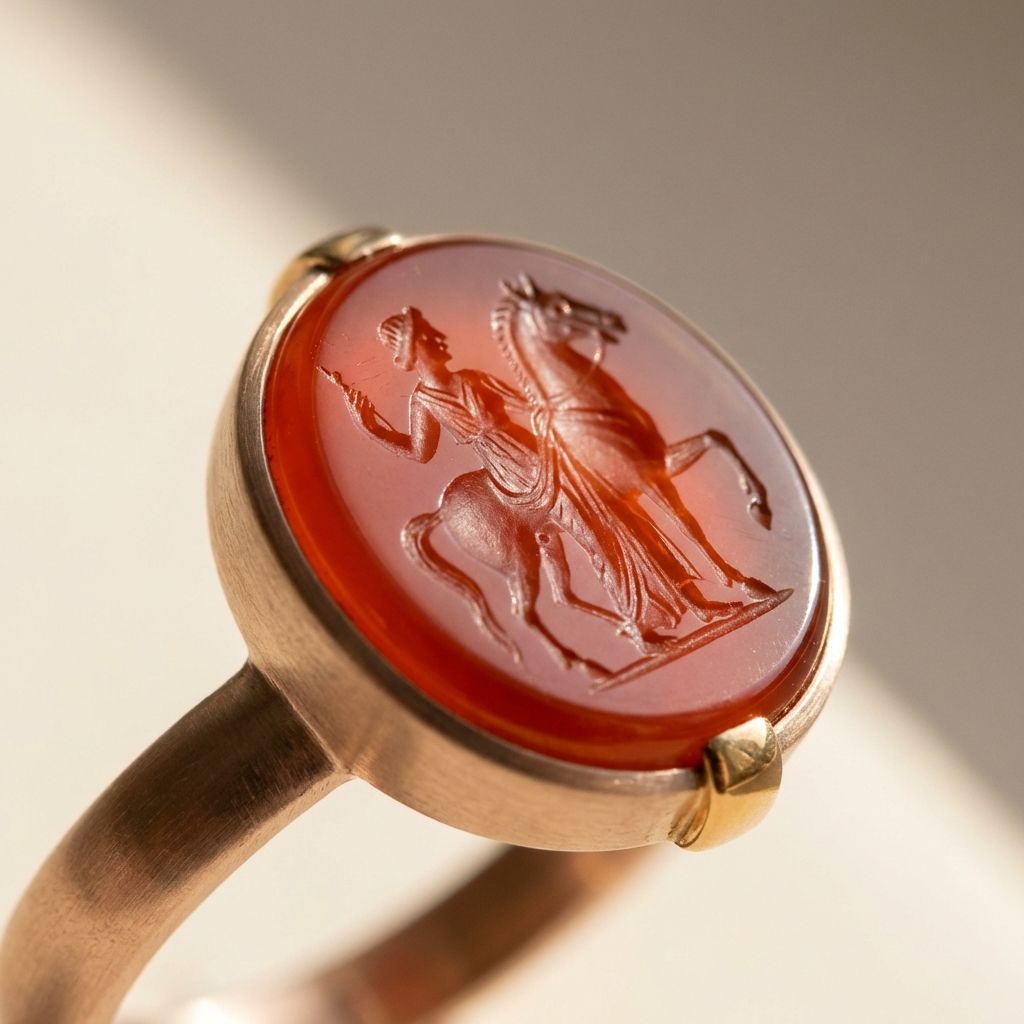
A practical way to think about the process is stepwise: rough shaping with abrasive grit, localised drilling for deep points or eyelets, and finishing with small wheel work for delicate lines; each step can produce microscopic signatures like rotating tool striations or concentrated abrasion zones that deserve attention.
Because those marks can also be mimicked or altered by later work, tool mark evidence is best used alongside typology, documented find history and high-resolution images to form a balanced interpretation Journal of Roman Archaeology review.
Intaglio versus cameo: the essential visual difference and why it matters
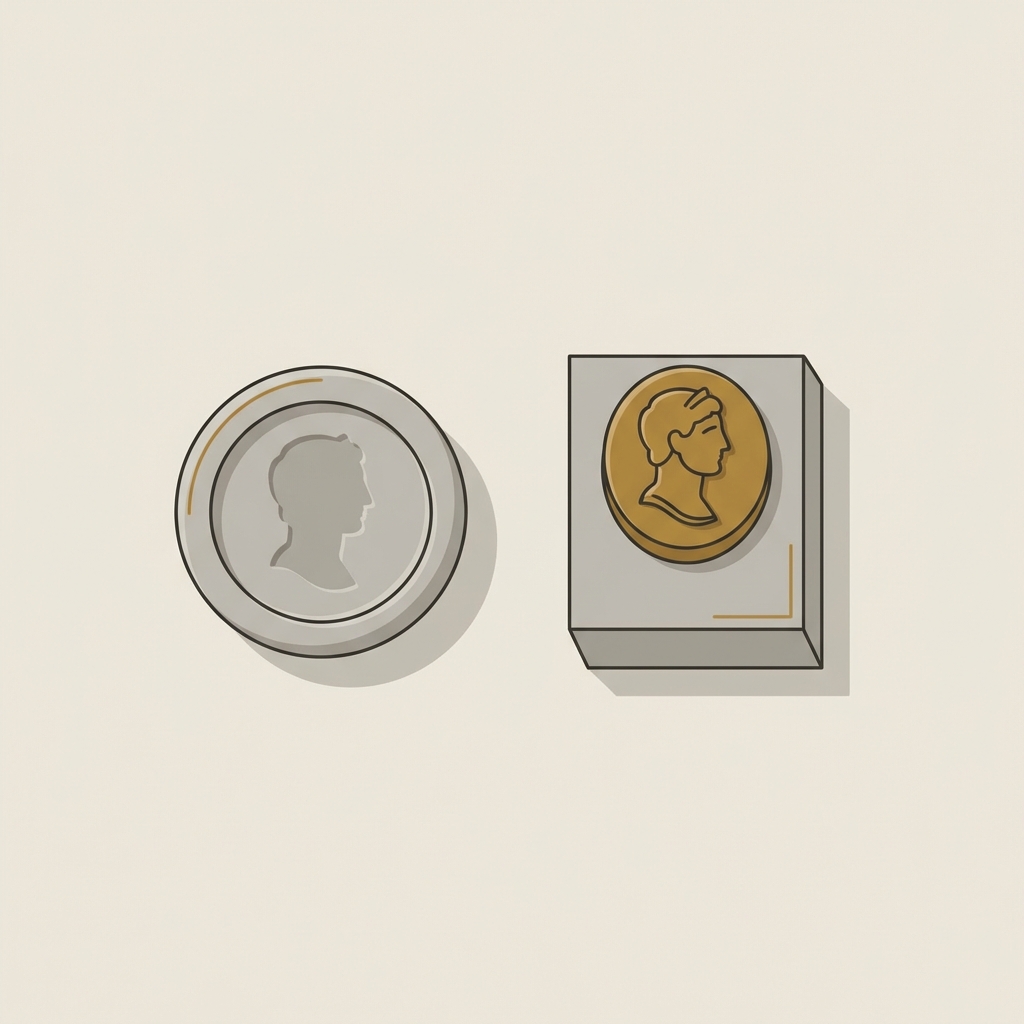
The key technical distinction is simple and important for identification: an intaglio is cut into the stone, creating a recessed image, while a cameo is carved in relief, often from layered material so the design stands out from the background Victoria and Albert Museum guidance.
That difference affects practical use and display because an intaglio reads as a positive image when impressed in wax, whereas a cameo is intended to be viewed directly as a raised image; knowing which you are looking at changes the questions you ask about wear, re-cutting and the object’s original function.
How to inspect and identify a roman intaglio ring: a practical checklist
Start with the basics: confirm the carving is recessed rather than raised, note the stone type stated or visible, and examine the setting for join style and signs of later soldering; when you rely on published typologies you can compare motifs and mounting styles with established examples British Museum collection term.
Next, look for wear consistent with age, such as softening of high points, edge patina on the metal, and microabrasion within incised lines rather than crisp fresh cuts; if text or inscriptions are present, check letter forms against dated comparanda in museum entries.
How can I tell whether a stone was recut or recently worked without specialist tools Begin by confirming the carving is recessed, examine the stone type and setting, request high-resolution and oblique images, and review any available provenance or condition notes before considering specialist testing.
Use magnification where possible to examine tool marks and drill channels, and ask sellers for photomicrographs or high-resolution images at oblique angles that reveal surface texture; a short report from a specialist photographer or conservator can materially increase confidence in an assessment.
When provenance is unclear, request condition notes, any previous sale or catalogue references, and whether non-destructive testing has been performed, such as Raman spectroscopy, which can be helpful in material identification but is not always reported by sellers.
Conservation and care for intaglio rings: safe handling and storage
Conservative care favours minimal intervention: avoid ultrasonic cleaners and strong chemical products which can harm both stone and metal, and prefer light dusting with a soft brush for surface dust as a first step Smithsonian Institution guidance.
Store intaglio rings in soft-lined boxes or padded compartments, maintain stable humidity and temperature to reduce stress on joins and organic residues, and limit handling to necessary inspection sessions to protect patina and fragile mounts.
For any cleaning beyond surface dusting or for material testing and stabilization, consult a trained conservator who can recommend non-destructive options and document any intervention in restoration notes Smithsonian Institution guidance.
Documentation and provenance: what to request when buying a roman intaglio ring
Ask sellers for collection history, prior ownership notes, catalogue or exhibition references and any verification letters; clear, contemporaneous documentation that links an object to a named collection or sale record meaningfully increases confidence in the reported history J. Paul Getty Museum glyptic resources.
Keep in mind that provenance is a strong indicator but not an absolute guarantee; well-documented pieces with matching images and condition notes typically allow a more confident assessment than items without any documented history.
Reasonable seller responses include provision of dated photographs, scans of old sale catalogues or letters from recognized collection holders; vague histories or evasive answers about prior ownership should prompt follow-up or a decision to pause the purchase.
Reading restoration notes and condition reports
Restoration notes commonly record whether areas were stabilised, if mounts have been repaired or replaced, and whether surfaces were cleaned; these entries help readers understand exactly what was altered and what remains original Smithsonian Institution guidance.
Transparent reports usually describe the method and materials used, for example a stabilising resin or a re-soldered bezel, and photographic documentation of major interventions is an important supporting item to request from sellers or catalogues.
Restoration is not intrinsically negative, but undocumented or poorly described repairs complicate provenance and condition assessment because they can mask original joins or tool marks that specialists use for dating and attribution.
Typical mistakes and pitfalls buyers and writers make
A common error is overreliance on a single feature such as patina or a single photograph; patina alone can be misleading because it can be partially simulated or the result of differential cleaning, so always seek multiple lines of evidence British Museum collection term.
Another frequent pitfall is misreading modern recutting or fresh tool marks as ancient detail; modern work can be detected by crisp new cuts, inconsistent microscopic striations, or solder joins that differ from expected historical techniques.
Finally, beware of absolute or sensational language in listings; careful phrasing and documented evidence are better indicators of a credible seller than superlatives or pressure tactics, so request high-resolution images and condition notes before deciding.
Practical examples: reading three listing scenarios
Scenario A, higher confidence: a listing with clear provenance that cites a collection history, includes dated photographs, detailed condition notes, and photomicrographs showing consistent tool marks and expected wear; these items together produce a more confident assessment than any single element J. Paul Getty Museum glyptic resources.
Scenario B, cautious interest: an attractive ring with good catalogue-style images and a believable motif but minimal provenance; follow-up questions should ask for oblique and magnified images, any previous sale references, and whether non-destructive testing has been performed.
Scenario C, red flag: a listing where close images reveal crisp, fresh cuts in incised lines, inconsistent solder joins, or a mismatch between claimed age and known typologies; in such cases seek a specialist opinion and consider declining the purchase if doubts remain.
When to seek specialist testing and conservator advice
Non-destructive options such as photomicrography and Raman spectroscopy can help identify materials and reveal microscopic surface features without harming the object; these techniques are often performed by conservation labs or analytical services when documentation alone is insufficient Journal of Roman Archaeology review. See a study on portable Raman spectroscopy.
estimate whether to commission Raman spectroscopy based on documentation and condition
simple triage tool
Seek a conservator when cleaning, stabilisation or invasive testing is being considered, and ask for a written treatment proposal and cost estimate before work begins; conservators can also advise whether non-destructive analytics are likely to resolve specific questions.
Conclusion: approaching a roman intaglio ring with informed caution
In summary, approach a roman intaglio ring by combining visual assessment, attention to materials and tool marks, and careful review of provenance and restoration notes; this multi-pronged method reduces reliance on any single clue and supports a reasoned judgement The Metropolitan Museum of Art.
Practical next steps are to request high-resolution images and condition notes, compare motifs and mounts with published examples, and involve a conservator or analyst if tests such as Raman spectroscopy or photomicrography are needed to resolve material or working method questions; see our blog post.
An intaglio is cut into the stone so the image is recessed, while a cameo is carved in relief; check whether the design appears sunken or raised and test how an impression would read for confirmation.
No, avoid ultrasonic cleaners and harsh chemicals; use a soft brush for dust and consult a trained conservator for any deeper cleaning or testing.
Ask for collection history, prior ownership notes, condition reports, high-resolution images, and any verification letters or catalogue references the seller can provide.
References
- https://www.metmuseum.org/toah/hd/gems/hd_gems.htm
- https://www.britishmuseum.org/collection/term/x5440
- https://www.getty.edu/art/collection/objects/?q=intaglio
- https://auroraantiqua.store/products/roman-silver-ring-auriga-red-jasper-intaglio-of-cock-drawing-a-chariot-driven-by-a-mouse-1st-3rd-century-ad-eu-57-us-7-5
- https://auroraantiqua.store/collections/ancient-roman-rings
- https://www.journalofromanarchaeology.org/article/techniques-ancient-gem-engraving
- https://journals.sagepub.com/doi/10.1177/0003702816662592
- https://www.vam.ac.uk/articles/intaglio-and-cameo
- https://www.researchgate.net/publication/305448646_Raman_spectroscopy_of_ancient_beads_from_devin_castle_near_bratislava_and_of_four_intaglios_from_other_archaeological_finds_in_Slovakia
- https://www.iris.unict.it/retrieve/ca2e4092-3047-4209-9573-47da3093cc27/Caggiani%20et%20al.%202023%20JRS.pdf
- https://www.si.edu/mci/english/learn_more/taking_care/jewelry_care.html
- https://auroraantiqua.store/collections/rings
- https://auroraantiqua.store/blogs/news/the-timeless-appeal-of-roman-jewelry-intaglio-rings-explained