


What an ancient roman coin necklace is and why people wore them
Definition: coin converted to pendant vs modern conversion (ancient roman coin necklace)
An ancient roman coin necklace refers to a Roman-period coin that was deliberately adapted to be worn on the body, typically by drilling a hole through the coin, attaching a small soldered loop, or fixing it into a mount so it could be suspended on a cord or chain. Collectors and curators often contrast such ancient conversions with modern suspension work, which can be identified by different tool marks and fresher metalwork; recognising that distinction is central to questions about meaning and date.
National finds-recording projects and museum collections document numerous Roman coins that were prepared or adapted for suspension, showing that wearing coins was a common enough practice in many places and periods Portable Antiquities Scheme.
Examine suspension wear and patina continuity, check for non-modern tool marks, and seek find-records or independent numismatic and conservation reports to corroborate physical evidence.
Most of the well-documented examples in institutional collections come from controlled finds or recorded discoveries, where the find context helps interpret purpose; museum catalogues and collection pages emphasise both intentional conversion and later adaptation as separate possibilities The British Museum.
Archaeological record and where examples come from
Archaeological evidence for suspended coins appears in a range of contexts, including graves, votive deposits, domestic sites, and chance finds, so a single recovered coin can have more than one possible interpretation depending on its context. When a coin is recorded with a findspot or in a curated collection, that recording often provides the strongest basis for saying it was worn in antiquity rather than altered later.
Where documentation is absent, physical signs on the coin itself become even more important for interpretation; later sections describe those diagnostic features in detail and show how find-records are used as benchmarks.
How coins were converted for wearing: physical signs and diagnostics
Common conversion techniques: drilling, loops, clips, suspension mounts
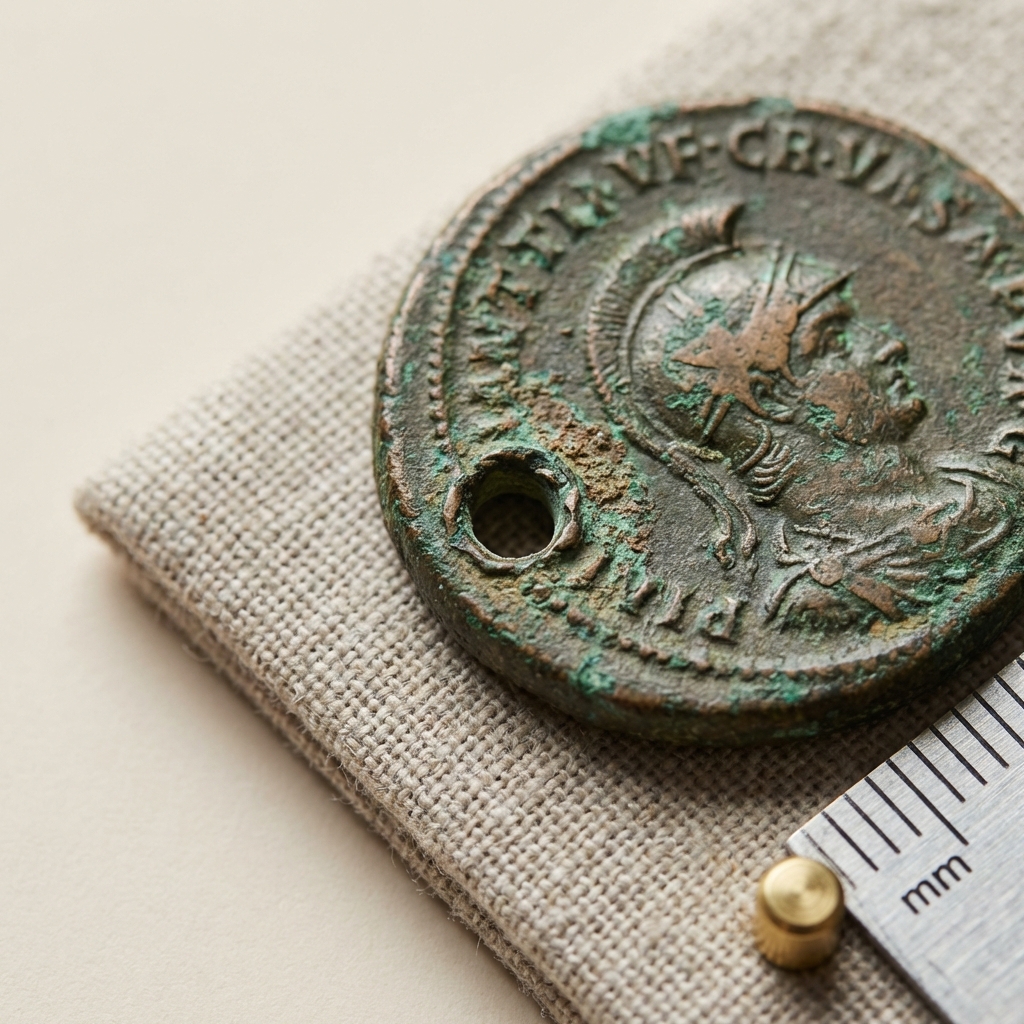
Coins were most commonly converted by drilling a small perforation through the flan or by attaching a thin metal loop into which a cord or chain could pass; some coins were set into metal mounts where the bezel held the coin edge. These visible alterations are often the primary evidence specialists use to say a coin functioned as jewellery rather than remaining a currency piece.
Curators and numismatists look for consistent suspension wear around any hole or loop and for tool marks that match ancient techniques rather than modern drill bits; such physical diagnostics are described in museum and finds-record guidance and form a core part of professional assessment Portable Antiquities Scheme, and practical authentication guides are available for collectors Navigating Vintage Coin Jewelry.
photos to request when assessing a suspended coin
Request high-resolution images under natural light
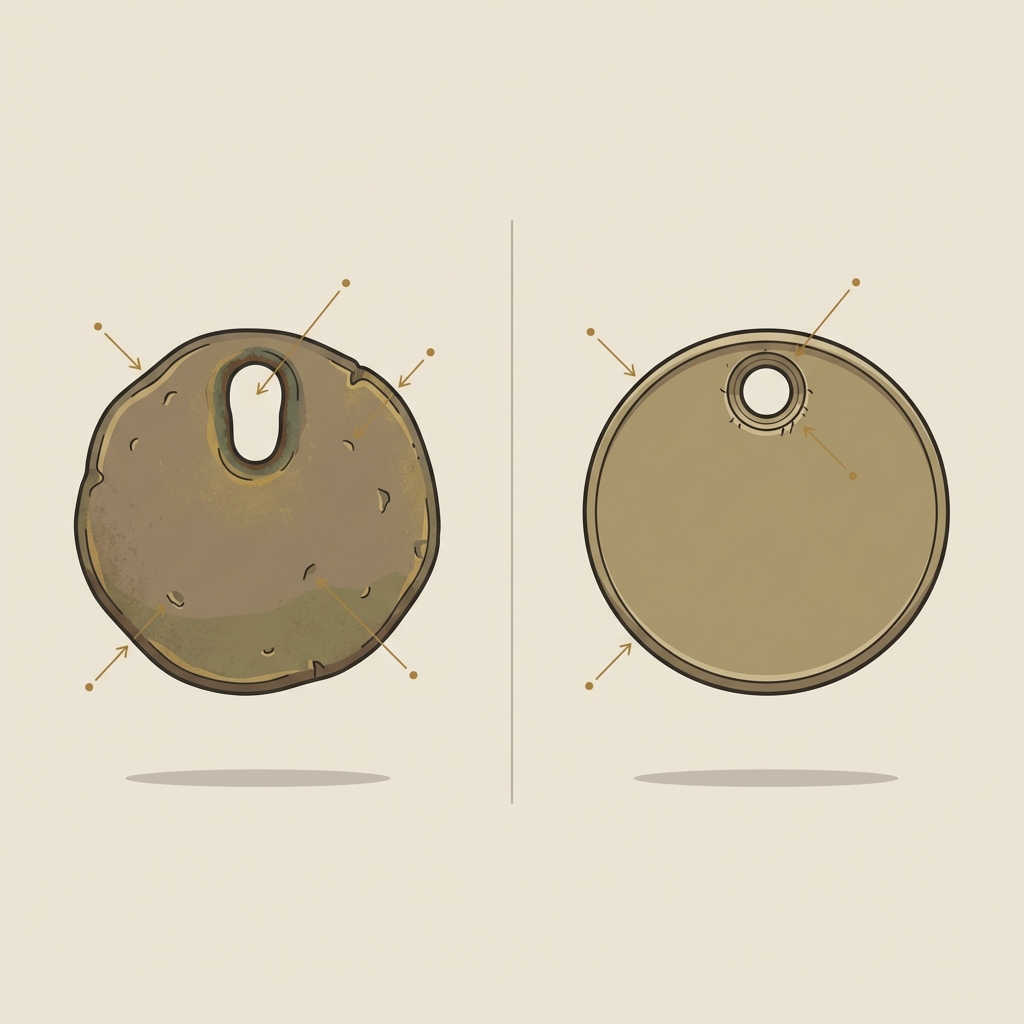
Wear patterns to look for include smoothing or consistent abrasion on the metal adjacent to a hole or loop, edge rounding from suspension movement, and a patina that is continuous over the altered area; breaks in patina or bright, freshly worked metal can indicate modern interference.
Independent provenance or a recorded find entry increases confidence that a suspension was ancient, because field-recorded finds link the object to a secure context rather than relying solely on physical appearance The British Museum.
Wear patterns to look for: consistent abrasion, edge smoothing, suspension wear
Consistent abrasion often appears as a narrow band of smoothing where a cord rubbed the metal over time; edge smoothing on the suspension rim is one of the clearer signs that a coin was suspended and moved while worn. In contrast, a modern hole frequently shows sharper, newer tool marks and a lack of coherent patina across the drilled edge.
Conservators also test for non-modern tool marks by comparing the microscopic morphology of the hole or loop with known ancient and modern examples, and they place weight on the overall coherence of wear patterns together with any supporting documentation Portable Antiquities Scheme.
How conservators and numismatists distinguish ancient work from modern alteration
Experts combine visual inspection, magnified examination of tool marks, comparison with museum-held exemplars, and the presence of a find-record to reach an opinion about whether a suspension is ancient. A single diagnostic alone is seldom decisive; rather, a suite of features increases interpretive confidence.
When a conserved coin is presented with a clear find history, professional reports or cataloguing entries reduce ambiguity by situating the piece in a temporal and cultural context; absent that, the surface evidence and comparison to documented examples becomes the main basis for judgement The British Museum.
For collectors, a conservator's report can also serve as useful documentation when assessing long-term care needs or when seeking further authentication through specialist examination.
Social meanings of a roman coin pendant: amulet, allegiance, or decoration?
Iconography and what certain motifs could signify
Iconography matters. An imperial portrait, deity depiction, or apotropaic symbol on a coin could plausibly have encouraged its use as a protective amulet or as a public statement of allegiance to an emperor; such readings derive from literary, iconographic, and artefactual parallels rather than from a single universal meaning The Metropolitan Museum of Art.

At the same time, a coin with an emperor's portrait could equally have been worn as a status signal, a local fashion item, or simply because the owner liked the image; archaeological reports stress that use is often contextual and polyvalent rather than fixed. Related historic pendants are available in our medieval pendants collection Aurora Antiqua medieval pendants.
Context matters: burial, votive, domestic, or display
Where coins are found in graves or votive deposits, the interpretive tendency is to read them as purposeful offerings or as items worn at death, which can suggest ritual value. By contrast, coins recovered from domestic or market contexts may more plausibly reflect everyday ornament and display.
Regional patterns in burial and hoard assemblages hint that the balance between ritual and decorative use varied across the Roman world; however, researchers note that systematic quantitative comparisons are still limited and that regional variation is an ongoing research topic Journal of Roman Archaeology.
Regional and chronological variation in use and meaning
Different provinces and time periods show distinct tendencies: in some areas, suspensions appear more often in funerary contexts, while in others they occur widely in settlement finds. Such variation underscores why a single coin's meaning must be argued from context, wear, and associated finds rather than assumed.
Iconographic associations, like deity imagery used apotropaically in other media, provide a plausible interpretive frame but do not prove that every coin with such imagery served a protective function for its wearer American Numismatic Society.
How to assess an ancient roman coin necklace before you buy
Checklist for images and listing descriptions
Request clear, high-resolution photographs that include: a close view of the suspension area, full obverse and reverse, an edge detail showing thickness and any drilled hole, a scale reference, and any documentation or find notices. These images are the minimum needed to begin an informed assessment and are straightforward to obtain from a seller or curator. For additional buyer-oriented commentary see a consumer guide on vintage coin jewelry identification Ancient Coin Jewelry: History You Can Wear.
Ask the seller to include condition notes, restoration and preservation notes, and any provenance statements or find-record entries; absence of these items increases uncertainty about antiquity and provenance Portable Antiquities Scheme.
See behind the scenes on @auroraantiqua: finds, restorations, and provenance notes
Before you proceed, request specific photos of the suspension area and any written find-records; these details often make the difference between a confident attribution and an ambiguous listing.
When images show a drilled hole, look for patina that continues across the hole edge and for smoothing consistent with long-term wear; if the hole has a sharp, bright rim with no patina, that is a warning sign and should prompt follow-up questions.
It is reasonable to ask a seller for a statement of what, if any, conservation was performed and whether repairs or modern mounts were added; sellers who provide restoration notes and condition descriptions help buyers evaluate risk and plan for proper care British Museum conservation guidance.
Questions to ask the seller or curator
Helpful questions include: Was this coin excavated and recorded? Is there a find-record or provenance paperwork? Are there independent numismatic or conservation reports? What exactly was done during any restoration or stabilization? These queries aim to move assessment from visual impression to documented evidence.
If the seller claims an ancient suspension, ask for close-up images of the suspension rim and for any microscopic or conservator notes that support that claim; photographic sequence and scale make technical inspection possible even at distance Portable Antiquities Scheme.
When to seek independent numismatic or conservation reports
For higher-value pieces or ambiguous cases, an independent numismatist or conservator can examine images or the object and provide a report noting tool-mark morphology, patina continuity, and any modern interventions; such reports increase buyer confidence and help document the object's history.
Independent reports are particularly advisable when provenance is incomplete or when images suggest possible modern alteration, because professional examination can separate surface-level impressions from more technical diagnostics British Museum conservation guidance.
Caring for metal coin pendants: conservation basics for collectors
Why cleaning can harm patina and diagnostic features
Household cleaning methods, abrasive polishing, and chemical dips can remove the thin patina that often preserves diagnostic details and obscures tool marks that help date a suspension; as a result, avoid amateur cleaning and seek conservation advice before any intervention.
Conservation guidance stresses minimal intervention and the use of stable, inert storage so that patina and subtle surface residues that inform dating and condition are preserved for future study British Museum conservation guidance.
Safe storage and handling recommendations
Store coin pendants dry and stable, away from fluctuating temperature and humidity, in conservation-grade materials such as acid-free boxes or inert plastic pockets; handle with clean gloves to avoid oils from skin transferring to the surface.
When displaying a suspended coin, avoid friction with other metals or coarse fibres and use padded mounts that do not abrade the suspension edge, since ongoing movement can alter suspension wear patterns and damage original patina.
When to consult a conservator
If a coin shows active corrosion, loosened mounts, or fragile surfaces, consult a professional conservator before attempting any treatment. Conservators can stabilise corrosion, document condition, and advise on reversible treatments that protect both material and archaeological information.
For collectors, a conservator's report can also serve as useful documentation when assessing long-term care needs or when seeking further authentication through specialist examination.
Common mistakes and red flags when buying a coin pendant
Over-reliance on attractive imagery or stylized listings
High-quality photos can make a modern alteration look convincing, so do not rely on appealing images alone. Instead, focus on the specific diagnostic images that show the suspension area and edge detail; if those are missing, treat the listing with caution.
Vague provenance, absent find-records, or listings that refuse to provide close-ups of the suspension area are common red flags and often merit either further inquiry or declining the purchase Portable Antiquities Scheme.
Ignoring suspension details or provenance gaps
Without clear photographs of the suspension rim, hole, or mount, you cannot evaluate whether wear patterns are consistent with ancient use; ask for edge closeups and a scale reference and insist on condition and restoration notes where possible.
Modern tool marks, which appear sharp and bright compared with surrounding patina, frequently indicate recent alteration rather than ancient working and are a decisive warning sign for cautious buyers The British Museum.
Misinterpreting modern repairs as ancient features
Modern soldered loops or contemporary mounts can be confused with ancient additions when pictures are small or poorly lit; when in doubt, request higher magnification images or an expert opinion rather than accepting ambiguous claims.
Polished surfaces and aggressive cleaning that remove corrosion or patina are often attempts to conceal diagnostic evidence and should reduce confidence in a seller's assertions about age or original use British Museum conservation guidance.
Practical examples and scenarios: reading listings and images
Case 1: coin with drilled suspension and find-record
Scenario: A listing shows a coin with a neat, worn hole, a consistent patina across the drilled edge, and an accompanying find-record entry from a national database. Assessment steps: compare the hole morphology with museum examples, ask for scaled close-ups, and verify the find-record entry if possible. If the documentation aligns and the wear appears coherent, the case leans toward ancient suspension Portable Antiquities Scheme.
Recommended next step: request a short written note from a numismatist or conservator if the purchase value warrants it; independent confirmation adds considerable assurance.
Case 2: coin with later soldered loop but ambiguous wear
Scenario: A coin has an attached soldered loop that looks older than modern repair but the suspension rim shows mixed patina. Assessment steps: ask for microscopic images of the solder join, seek any restoration notes, and compare with documented museum mounts; ambiguity here often requires expert input before buying.
If documentation is absent, an independent conservation assessment or refusal to buy until better images or reports are provided is a prudent course of action The British Museum.
Case 3: modern-holed coin with fresh tool marks
Scenario: The coin appears freshly holed with a bright, sharp rim and no continuity of patina. Assessment steps: treat the listing as modernly altered, request provenance evidence, and if none is forthcoming, decline the purchase. Modern holed coins are common on the market and often sold as vintage-style jewellery rather than genuine ancient pendants.
Recommended next step: compare the listing with museum examples and refuse to proceed without a convincing provenance or an independent report, especially for higher-priced pieces Journal of Roman Archaeology. For a practical how-to on checking images and surface characteristics, see our guidance on how to tell if a Roman coin is real how to tell if a Roman coin is real.
Across scenarios, the recurring theme is the same: documentation, high-quality images, and, when appropriate, independent reports are the principal tools for distinguishing plausible ancient practice from modern alteration.
Summary: what wearing an ancient roman coin necklace likely signified and next steps for collectors
Suspended Roman coins can legitimately be read as protective amulets, statements of allegiance, decorative display, or combinations of these, depending on iconography, find context, and regional practice; no single meaning fits all cases The Metropolitan Museum of Art.
Top actions for buyers are clear: inspect the suspension area carefully, request provenance and condition documentation, and follow conservation guidance if treatment is needed. Museum comparisons and independent numismatic or conservation reports provide the best route to reduce uncertainty and to make an informed purchase decision British Museum conservation guidance, or visit the Aurora Antiqua homepage for related products and resources Aurora Antiqua.
Look for consistent suspension wear, patina continuity across a hole or loop, and any supporting find-record or provenance; if uncertain, obtain an independent numismatic or conservation opinion.
No, avoid household cleaning; cleaning can remove patina and diagnostic features. Request condition notes and consult a conservator before any treatment.
For higher-value purchases, ambiguous suspension features, or incomplete provenance, an independent numismatist or conservator report is advisable to clarify authenticity and condition.
References
- https://finds.org.uk/news/2016/05/23/coins-as-jewellery/
- https://www.britishmuseum.org/collection/galleries/roman-britain
- https://pendantandring.com/2024/10/17/navigating-vintage-coin-jewelry-authentication-appraisal-guide/
- https://www.britishmuseum.org/our-work/conservation/collections-care
- https://www.metmuseum.org/toah/hd/jwl/hd_jwl.htm
- https://auroraantiqua.store/collections/medieval-pendants
- https://www.journalofromanarchaeology.com/articles/coin-pendants-and-personal-ornament
- https://numismatics.org/pocketchange/coins-amulets/
- https://faruzo.com/blog/ancient-coin-jewelry/?srsltid=AfmBOoo80dbRtZ_dxlQ8BIK74mSVZWDXmd5rioBynFHZkssJXXkpEJRX
- https://auroraantiqua.store/blogs/roman-empire/how-to-tell-if-a-roman-coin-is-real
- https://auroraantiqua.store/