


Definition and context: what the triskelion motif stands for
Visual forms and basic vocabulary, triskelion ring meaning
The term triskelion or triskele refers to a motif with three radiating arms or legs that meet at a central point and rotate around an axis. It can appear as three legs, three spirals, or three bent arms in decorative work, and the precise visual vocabulary matters for interpretation.
The motif predates its later civic uses and is recorded across different regions and periods, which means its meaning depends on context: iconography, the object type and any accompanying inscription all shape how an individual piece should be read. For surveys of the motif across regions, see the Encyclopaedia Britannica overview of the triskelion motif for broader context Encyclopaedia Britannica triskelion overview.

For collectors, the basic glossary is useful: triskele for spiral or three-armed forms, triskelion often used where three legs are depicted, motif when referring to decorative or symbolic use, and iconography for the broader symbolic program. Treat these as descriptive labels rather than fixed meanings without supportive evidence.
Why the motif matters to collectors and historians
The motif appears on many object types, from coins and seals to decorative metalwork, and each object type has different conventions for inscription and symbolism. Because the same visual form can carry ritual, civic, or decorative roles in different cultures, a careful reading must combine visual analysis with object context and dating.
Collectors who encounter a triskelion on a ring should therefore ask whether the motif is the primary message, a decorative panel, or an emblem later associated with a civic identity, and should avoid assuming a single fixed meaning across time and place.
The Isle of Man motto attached to the three legs
Official wording and common English translation
The Latin motto most widely linked to the three-legged triskelion is Quocunque jeceris stabit, commonly translated as whithersoever you throw it, it will stand. This wording and its translation are presented in modern official sources for Manx heraldry Tynwald, Coat of Arms and Motto. Coat of arms of the Isle of Man (Wikipedia).
That rendering is the authoritative civic form used in contemporary descriptions of the Isle of Man arms, and it is the phrase most often cited when writers explain the triskelion as a symbol of resilience or constancy in a Manx context.
Manx cultural sources and heraldic usage
Manx heritage and cultural bodies treat the motto as an established element of local heraldry and provide contextual histories and descriptions for the symbol as used by civic institutions and public bodies Manx National Heritage, The Three Legs.
For a collector this means that if an object is legitimately linked to Isle of Man civic usage then modern Manx sources are the right reference for translations and civic meaning, but the same motto should not be assumed for visually similar motifs from other regions or earlier periods.
When and where the triskele appears in older collections
Museum records and geographic spread
The triskele appears across Iron Age, classical and medieval Mediterranean and Atlantic finds, showing the motif was widespread long before it became specifically associated with any single modern civic emblem. Surveys and museum catalogues document this broad presence of the motif Encyclopaedia Britannica triskelion overview.
Object types with recorded triskeles include coins, stamped and cast decorative items, and small metalwork, which means collectors should consider parallels from a range of object classes rather than looking only at rings.
Timeline from Iron Age to late antiquity
Catalogued examples and reference collections record continuity and variation in the motif from the Iron Age through classical periods into late antiquity, with regional styles and workshops producing recognisable variants in form and execution Encyclopaedia Britannica triskelion overview.
Because the motif crosses long chronological spans, attributing a single origin is not helpful; instead, comparative typology and contextual dating are the tools for situating an object in time and place.
quick public collection search checklist to find museum parallels
use each field to narrow results
How the motto and short inscriptions relate to wearable objects
Differences between coins, seals and rings
Museum catalogues show that triskelion motifs are more commonly documented on coins and seals than as full Latin motto inscriptions on medieval rings, which affects how confident a reader can be when a ring is presented as bearing the full Quocunque phrase British Museum, triskelion collection overview.
Coins and seals often carry short legend panels and are made to be read at small scale, while rings present a smaller writing surface and a higher likelihood of later engraving, repair or wear that complicates reading of inscribed text.
Why full motto inscriptions on rings are comparatively rare
Studies of medieval rings and inscriptions note that full Latin mottoes are comparatively uncommon on securely dated early rings, and that abbreviated or vernacular variants are more typical on later commemorative items Journal of Medieval Material Culture article on mottoes and motifs.
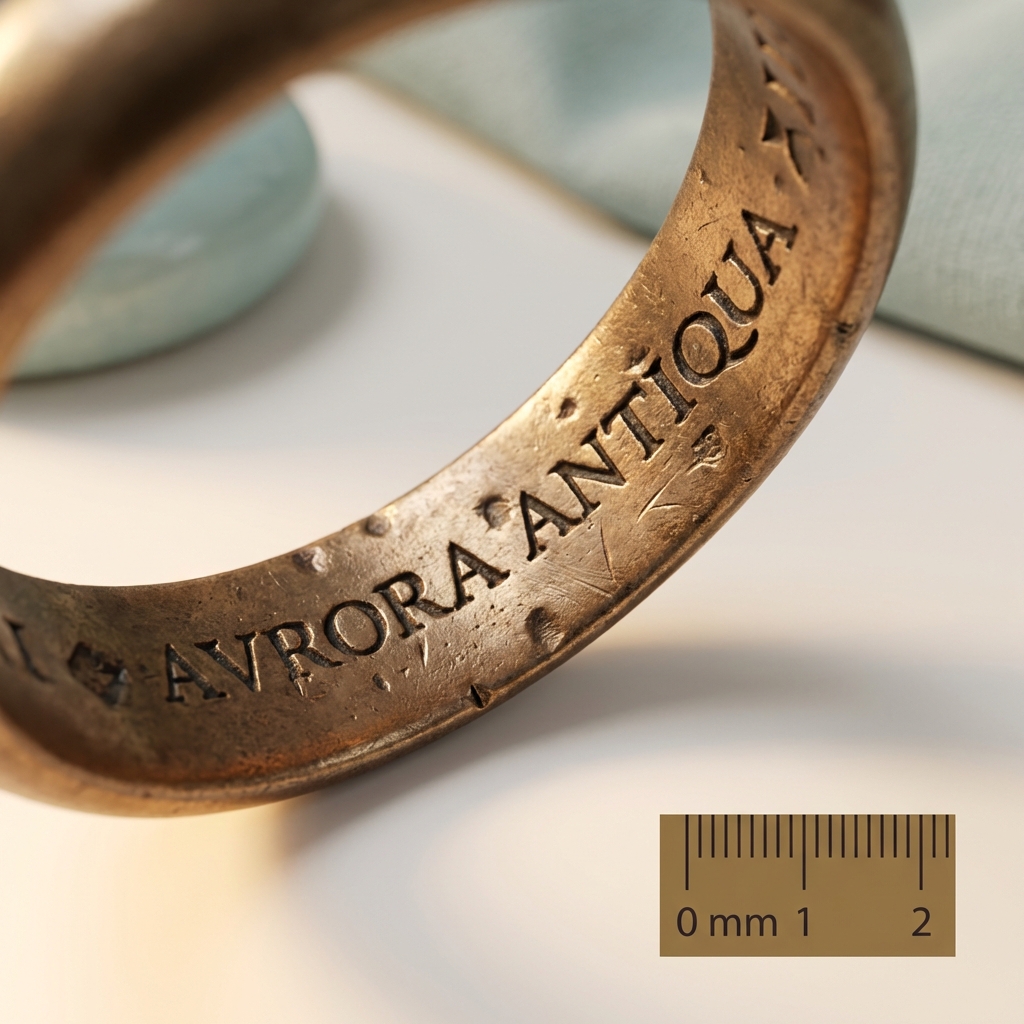
For collectors this means encountering a full Quocunque inscription on a ring should prompt careful scrutiny of letter forms, wear patterns and provenance rather than immediate acceptance of the reading.
Reading motto inscriptions: what collectors should check
Photographs, letter forms and palaeography
To assess an inscription on a triskelion object, request high resolution close ups of the inscription in raking light, and if possible photographs at multiple angles so letter profiles and tool marks are visible. Where the claim is that a ring bears the Latin motto, the letter forms should be compared to dated epigraphic parallels rather than to modern fonts.
When a concrete inscription claim is made, compare letter shapes with museum examples and specialist catalogues; if the seller references a particular museum parallel ask for the citation and check it independently for form and date Encyclopaedia Britannica triskelion overview.
Provenance, catalog parallels and documentation
Provenance is central: collection history, prior ownership notes and verification letters strengthen an attribution. Without clear provenance, inscriptions on small wearable objects are at higher risk of being later additions or modern forgeries.
Best practice in 2026 remains to prioritise items with clear provenance and photographic documentation and to compare claimed inscriptions against dated museum examples before accepting a canonical reading of Quocunque jeceris stabit on a ring Tynwald, Coat of Arms and Motto.
Dating, variants and motto evolution over time
Epigraphic variants and amateur readings
Scholarly studies record motto like variants, abbreviations and vernacular slogans appearing on later commemorative rings and other objects, which shows that readings of a full Latin motto on a wearable piece can reflect later adaptation rather than an original ancient inscription Journal of Medieval Material Culture study on motto variants.
This tendency means collectors need to watch for inconsistent letter spacing, mixed letter forms and signs of recent tooling that may indicate a later engraving rather than an original medieval work.
How later commemorative objects can introduce motto variants
Commemorative pieces from the modern era sometimes appropriate historic motifs and add mottoes in full or in shortened form, creating objects that look historical but whose inscriptions reflect later cultural meanings rather than original usage. Museum and journal literature discuss these phenomena and caution about simple visual matches without documentation Journal article on mottoes and motifs.
Because of this, a triskelion bearing ring sold as carrying the Isle of Man motto should be assessed on the combined evidence of provenance, letter forms and catalog parallels.
Practical steps for collectors: a verification framework
Checklist before purchase
1) Ask for high resolution images of the inscription, including raking light and side views.
2) Request documented provenance, such as collection history, prior ownership notes or verification letters, and list what is missing.
See provenance and restoration details behind the pieces
Review listings that present clear condition and restoration notes, and favour curated ancient rings with documented provenance when possible; Aurora Antiqua presents pieces with contextual editorial notes to help this work.
3) Compare the letter forms with dated museum examples and specialist catalogues; where similarity is claimed, ask for the specific museum citation to check independently.
4) If the inscription reads as Quocunque jeceris stabit, ask whether the seller can provide an epigraphic assessment or a comparative reference rather than relying on visual similarity alone.
Who to consult and what documentation matters
Useful documents include written collection history, prior sale or catalog entries, restoration notes describing what was stabilised or repaired, and any verification letters from recognised specialists. These items do not guarantee an attribution but they enable more reliable judgments.
When in doubt, independent comparison with museum records and consultation with a specialist in medieval epigraphy or metalwork is the conservative choice for significant purchases Encyclopaedia Britannica triskelion overview. (See our Roman Empire blog.)
Common mistakes and how to avoid them
Misreading worn inscriptions
One common error is to read worn or corroded marks as complete Latin words, filling gaps mentally to form the expected motto. Wear consistent with age can distort letters and create misleading profiles.
The Latin phrase Quocunque jeceris stabit is the motto most closely linked to the Isle of Man triskelion in modern civic usage, but because the triskele motif predates that association, attributing the full motto to a ring requires careful evidence such as provenance, readable letter forms and museum parallels.
Another error is to rely on visual similarity alone. A three-legged motif resembling a Manx emblem does not mean the object originally carried that civic meaning, because the motif predates the Isle of Man usage by centuries and appears in many cultural settings Encyclopaedia Britannica triskelion overview.
Over relying on visual similarity alone
Avoid assuming a shared meaning across different periods; instead, ask for comparative dating evidence and provenance. If an inscription is central to attribution, insist on readable photographs and independent catalog parallels rather than a seller description alone.
When a seller uses definitive language about an inscription without supporting documentation, treat the claim as a prompt to request more evidence rather than as settled fact.
Short case studies: museum examples and auction notes
Select catalogued objects showing triskelion motifs
Public collections such as the British Museum and The Metropolitan Museum of Art document triskelion forms across coins, seals and decorative objects, which provides a range of parallels for comparative study British Museum triskelion collection overview. See also CRW Flags.
Instances where motto attribution was clear or ambiguous
In some catalogued cases inscriptions and clear provenance support a confident reading, while in other instances auction descriptions relied on visual similarity with limited documentation, producing ambiguous attributions. For searchable examples consult major museum collection entries and compare object types and datings The Metropolitan Museum of Art search results for triskelion.
These contrasts illustrate why collectors should prefer items with explicit documentation rather than accepting a motto claim without photographic and provenance support.
Interpreting provenance and documentation for rings
What counts as useful provenance
Useful provenance includes a chain of ownership, catalog citations, or inclusion in a named collection with verifiable records. Prior auction or sale records can help but should be matched to photographs to confirm identity.
Verification letters from recognised specialists or institutions add weight, but the content matters: a letter describing the inscription, letter forms and condition is more helpful than a general statement of age.
How restoration notes affect reading of inscriptions
Restoration notes that state whether an inscription area was stabilised, repaired or left untouched are crucial because conservation work can alter surface features and introduce modern tool marks. Prefer listings that describe conservation treatments clearly.
If restoration notes are missing or vague, treat inscriptions with increased caution and seek independent examination or clearer photographic evidence before accepting a motto attribution.
Care, display and condition notes for wearable artifacts
How condition affects legibility
Corrosion and patina can obscure or change the appearance of letters, while mechanical wear can flatten strokes. Conserved surfaces may show polishing or filling that affects reading, so condition notes should be taken seriously when assessing legibility.
Ask for images under raking light and note any areas listed as stabilised or filled in restoration notes, because these interventions can change the clarity of lettering.
Safe display and handling recommendations
Handle ancient rings with gloves, avoid unnecessary mechanical cleaning, and store pieces in stable humidity and temperature conditions to protect patina. For display, low light levels and secure mountings help preserve surfaces for future study.
Share restoration and condition notes when selling or consulting, since transparent notes assist later researchers and buyers in understanding what was done to the piece.
Restoration, preservation and editorial content expectations
What restoration notes should say
Good restoration notes are specific: what was stabilised, any repairs made, whether fills are reversible and whether inscribed areas were left untouched or retouched. This clarity helps assess whether inscriptions are original or later interventions.
Prefer vendors and catalogues that provide explicit condition and restoration notes rather than vague statements, because specificity supports independent verification and careful comparison to museum parallels.
How editorial context clarifies cultural background
Editorial content should supply cultural and historic context, references to comparable objects, and clear language about dating assumptions. It should avoid asserting absolute authenticity without supporting documentation, and instead present evidence and comparison points.
A calm, contextual editorial approach helps collectors understand why a claim is made and what evidence supports it, aligning with best practices for ethical presentation of antiquities.
Buying checklist and red flags
A final pre purchase checklist
- Request high resolution photos, including raking light and detail shots of inscriptions.
- Ask explicitly for provenance details, restoration notes and any verification letters.
- Request specific museum parallels or catalogue citations to support inscription readings.
- Use conservative language in a purchase query, for example ask Is there documented provenance for this inscription rather than asserting the motto is present.
Top red flags to avoid
- Vague or missing provenance, poor or absent photographs, and absolute authenticity claims without documentation are all reasons for caution.
- Descriptions that claim a full Latin motto without showing readable letter forms or providing comparative citations should be treated as unverified until evidence is supplied.
Conclusion: what the motto means for collectors today
Quick summary
The Latin motto Quocunque jeceris stabit is the form most closely associated with the Isle of Man triskelion in modern civic and heraldic contexts, and contemporary Manx sources are the right reference for that civic meaning Tynwald, Coat of Arms and Motto.
At the same time the triskele motif is far older and appears in many regions and object types, and full motto inscriptions on rings are comparatively uncommon and should be verified with provenance and epigraphic comparison before being accepted as the canonical phrase Encyclopaedia Britannica triskelion overview.
The commonly given English translation of the Manx Latin motto Quocunque jeceris stabit is whithersoever you throw it, it will stand.
No, the triskele motif predates the Isle of Man and appears across Iron Age, classical and medieval Mediterranean and Atlantic contexts, so context and provenance determine meaning.
Request high resolution inscription images, provenance documentation and comparative museum references, and seek an epigraphic comparison before accepting a full motto reading.
References
- https://www.britannica.com/topic/triskelion
- https://auroraantiqua.store/products/roman-silver-ring-auriga-red-jasper-intaglio-of-cock-drawing-a-chariot-driven-by-a-mouse-1st-3rd-century-ad-eu-57-us-7-5
- https://www.tynwald.org.im/about/the-coat-of-arms/
- https://manxnationalheritage.im/collections/symbols/three-legs/
- https://auroraantiqua.store/collections/ancient-roman-rings
- https://www.britishmuseum.org/collection/term/x36172
- https://www.jstor.org/stable/medmatcult.2020.10105
- https://auroraantiqua.store/collections/rings
- https://auroraantiqua.store/blogs/roman-empire
- https://www.metmuseum.org/search-results#!/search?q=triskelion
- https://en.wikipedia.org/wiki/Coat_of_arms_of_the_Isle_of_Man
- https://en.wikipedia.org/wiki/Isle_of_Man
- https://www.crwflags.com/fotw/flags/im.html