


Quick overview: what this guide covers
This guide is a practical, museum informed field reference for readers who want to identify common knot motifs on small objects, especially ancient celtic ring money. It treats the so called "eight" knot categories as a modern teaching device and not a fixed medieval catalogue, and it focuses on how scale, execution and documentation change what you can reliably identify on rings and ring money. For readers planning purchases or research, the emphasis here is on observable features, condition and provenance rather than asserted symbolic meanings, and the article uses examples and collection sources to illustrate the points Metropolitan Museum of Art overview of Celtic art.
How to use this article for rings and small artifacts The pieces most relevant to collectors are compact: bands, hooped rings and small coin like objects where knotwork is usually simplified to repeats or narrow plaits. Where the wording below refers to "line continuity" or "terminals" it is because those are the cues that remain legible at ring scale, as seen in both manuscript panels and museum metalwork Oxford Reference entry on interlace and knotwork. For related items see our Celtic Rings collection.
What is Celtic knotwork and why the 'eight' list is a teaching choice
Museum and reference sources characterise Celtic knotwork as a family of interlace and plait motifs that appear across Insular art rather than a single fixed symbolic system. That means the categories collectors see in modern guides are convenient labels for recurring visual patterns, not a contemporary inventory used by medieval makers Metropolitan Museum of Art overview of Celtic art.
Follow @auroraantiqua for behind the scenes on ring finds and documentation
This guide is intended as an identification aid for collectors. Before buying an ancient piece, check condition notes and any available documentation so you can judge execution and provenance for yourself.
Categories such as plait, braid, key pattern, triadic knots and endless knots are recurring motif families that scholars use to teach identification because they help organise visual variation in manuscripts and metalwork. Editors often reduce the variety to a small number like eight for clarity, but that editorial choice compresses regional variety and evolution over time Oxford Reference entry on interlace.
Limits of calling any list canonical are practical and methodological. Knot motifs evolved regionally and were adapted across media and centuries, so the same descriptive label can cover distinct local variants. Treat the eight categories here as starting points for comparison with museum images and condition notes rather than as definitive historical taxonomy Encyclopaedia Britannica overview of Celtic art.
How knot motifs were used across media and simplified on small objects
Manuscripts such as Insular Gospel books and metalwork share a common vocabulary of interlace and plait motifs, but the two media use the vocabulary differently. Manuscript panels can afford long, continuous interlace runs and dense crossings, while metalworkers on small rings had to simplify line width, crossing counts and terminals to suit casting or chasing techniques Book of Kells resources. For a general overview of knot types see this guide to Celtic knot types Celtic Crystal guide to knot types.
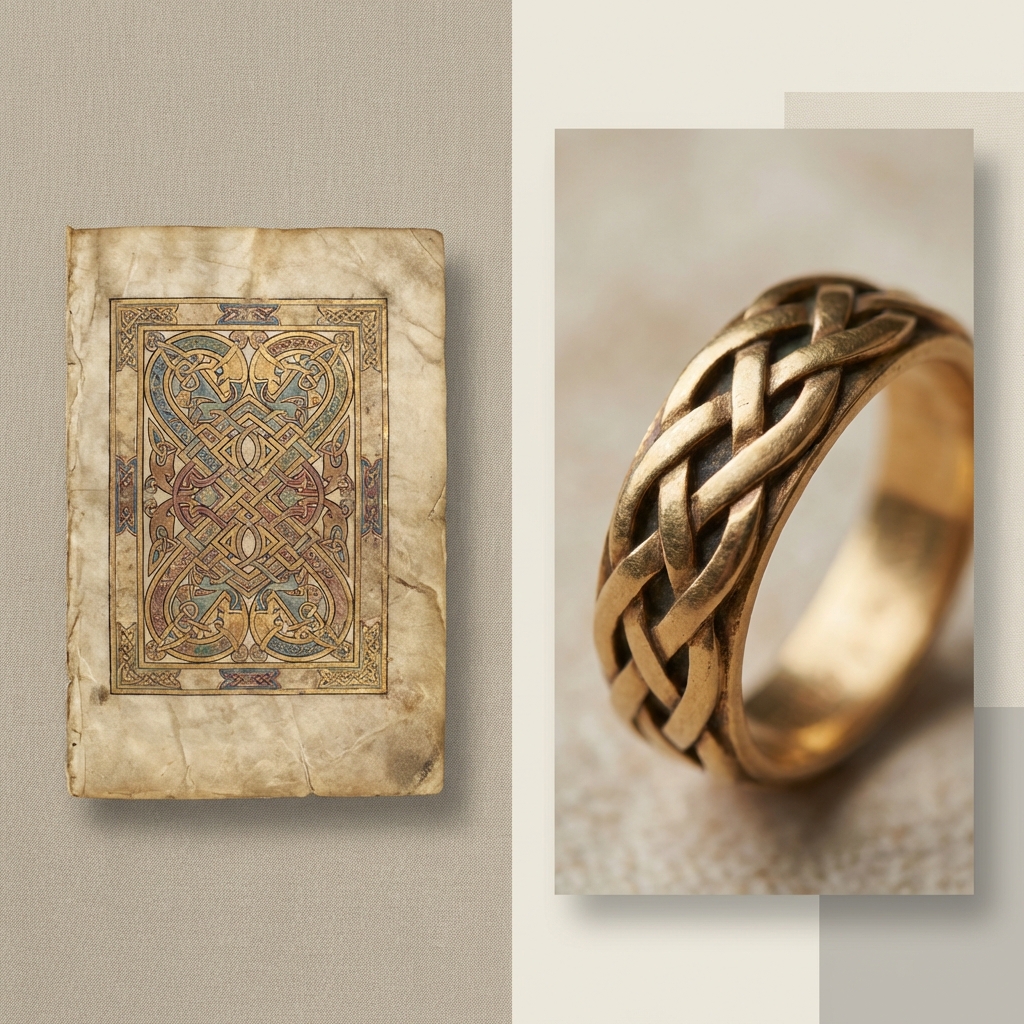
On small metal objects like rings and ring money the most reliable motifs are plaits, braided bands and simple key patterns, which scale well and survive wear. Technical limits of casting, engraving or stamping on narrow bands favour repeated motifs or compressed panels rather than elaborate uninterrupted knotwork National Museums Scotland stories on Celtic art.
For identification on rings, focus on continuity of the braided line, how many times the strand crosses itself within a repeat, the presence of symmetry axes, and how terminals are finished. These cues often remain visible even where fine detail has been lost to wear or corrosion Book of Kells research on ornament.
Identifying the eight common knot types on ancient celtic ring money
The following subsections describe eight commonly taught knot categories and give short, ring scale friendly identification cues. Use them as visual checklists when comparing a listing photograph or a museum image; remember that overlap and hybrid forms are common and that many small rings show simplified repeat bands rather than a single continuous panel Oxford Reference on knot families.
Plait or braid
Identification cues: continuous interleaving strand, usually two or three strand plait, repeated along the band; crossings are regular and the pattern has a single symmetry axis across the band. On rings this appears as a narrow band of alternating over and under crossings rather than a closed panel. Look for consistent spacing of crossings and the same terminal treatment at each repeat.
Key pattern
Identification cues: rectilinear repeats, angular junctions and small right angle turns that create a maze like effect; symmetry often in two axes at the repeat cell. On ring money key patterns are often rendered as short repeats because long runs would be fragile or technically difficult to cast or engrave.
Triquetra and triadic knots
Identification cues: threefold rotational symmetry, often with three lobes or a three strand twist meeting at a central point; terminals may tuck under or hook back. In reduced ring forms the triadic motif may appear as a compact three lobed loop or as abbreviated paired loops suggesting a triquetra rather than as an elaborate interlace panel.
Spiral interlace
Identification cues: flowing, curving lines that coil or spiral, often creating nested loops; crossings are less regular and the overall impression is of rotation rather than straight repeats. On rings spirals are easier to render in relief and often survive as shallow incised or cast swirls.
Endless knot
Identification cues: the appearance of a continuous pathway with no visible start or finish in the motif, often built from repeating linked units. On small bands the endless knot frequently reduces to a sequence of linked loops that suggest continuity rather than a large uninterrupted maze.
Step or maze key
Identification cues: stepped lines that create angular pathways, shorter repeat cells, and a tendency toward rectilinear geometry. At ring scale these are often used as filler bands between other motifs and can be mistaken for simple geometric ornament if crossings are obscured by wear.
Hybrid and compound knots
Identification cues: combinations of two motif families, for example a plait that terminates into a triquetra or a key pattern that is overlaid with a spiral element; on rings hybrids are common because makers adapted familiar motifs to limited space, producing compact variants with mixed cues.
Simplified plait forms on small rings
Identification cues: very narrow braids, often with one dominant strand and scored groove marks rather than clear over and under crossings; these simplified plaits are especially common on ring money and small hoops because they survive casting and wear and still convey a braided look at close range.
identification worksheet for ring scale knot motifs
Use alongside high resolution photos
When you compare images, work through the checklist above for each band section. Measuring band width and repeat length helps decide whether a visual pattern is truly a plait or a compressed key pattern, and noting how terminals are finished reduces false positives where damage or repair mimic intentional ends Book of Kells documentation on ornament.
Visual cues and measurement tips for small rings
Photographing and zooming details Request macro photos of the band from several angles: a full band view, a tightly cropped detail of the motif, images of terminals, and a scale reference such as a metric ruler or calipers in frame. These images let you check repeat length, symmetry and whether the motif runs under an applied bezel or around joins; clear photos reduce the need to guess about pattern continuity National Museums Scotland guidance on metalwork ornament.
Measurements and scale cues to note Band width in millimetres, motif repeat length, and depth of incisions or relief are the most useful numbers for ring scale identification. For example, a braid that repeats every 4 to 6 mm will look different in execution to one that repeats every 1 to 2 mm; noting these values helps when you compare to collection plates or manuscript panels reduced to band scale.
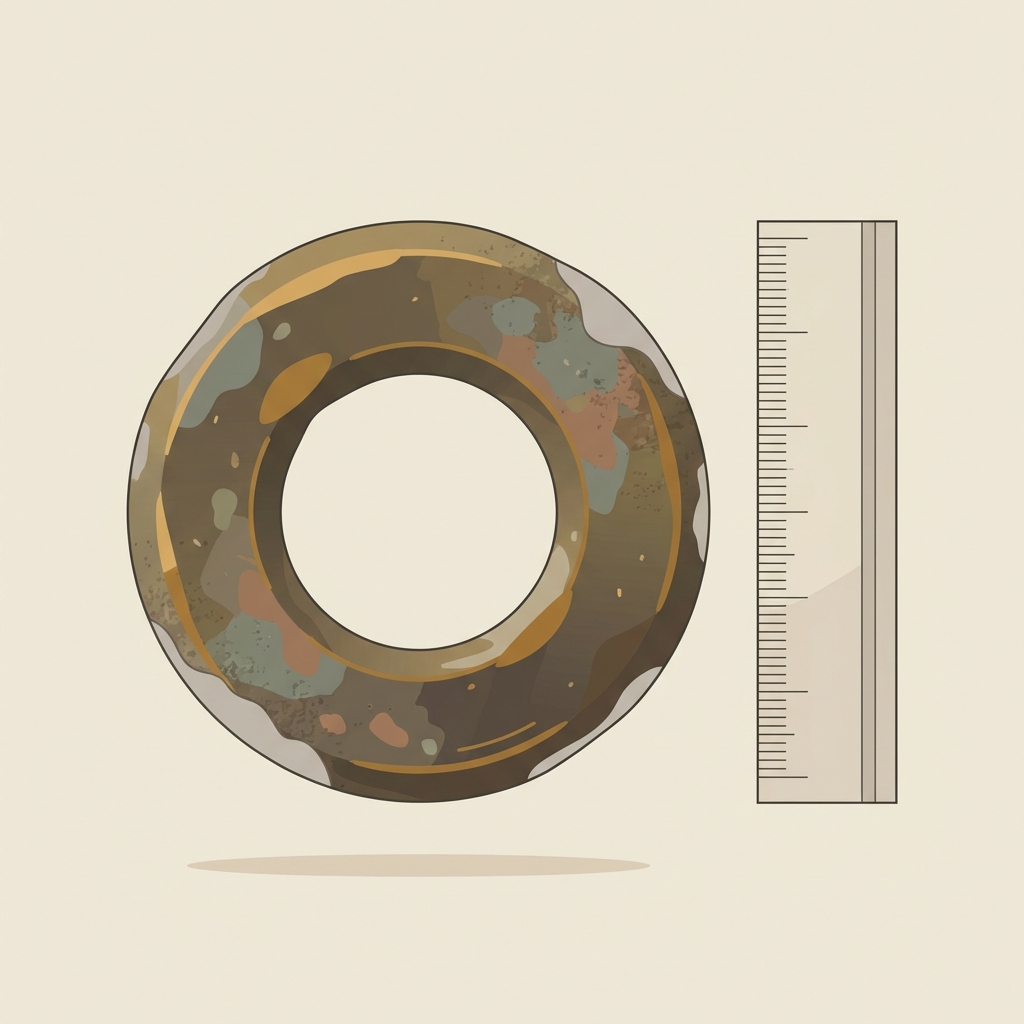
How patina and wear affect visible knot details A stable, even patina that follows the motif outlines can preserve crossings as shallow tones rather than sharp lines. Conversely, corrosion and surface pitting can fill or obscure incised crossings and make terminals appear blunted or broken. Always ask whether visible irregularities are original tool marks, later repair, or loss from corrosion, and request condition notes when available Book of Kells research on ornament.
Questions to ask and documentation that matter for buyers
Provenance and collection history Key items to request when considering a purchase are documented provenance notes, prior ownership information, and any available verification letters or conservation records. These documents increase interpretive confidence by tying a piece to a collection history and published comparisons rather than relying solely on motif labels in a listing Encyclopaedia Britannica overview of Celtic art. You can also contact the seller directly via our contact page to request records.
Focus on observable cues: line continuity, crossing counts, symmetry axes, terminal treatment, and repeat measurements; always corroborate visual identification with provenance and condition records.
Condition and restoration notes Ask for a written condition summary that describes any stabilization or repairs, and whether alterations were made after excavation or acquisition. Clear restoration notes make it easier to judge how much of the knot detail is original and how much may be modern intervention, which in turn affects how confidently you can classify a motif.
Useful phrasing for listings and enquiries to sellers Include conditional phrases such as "estimated dating", "described material", and "condition notes describe" to avoid implying certainty. For example you might ask: Can you provide provenance records, recent high resolution photos of the band with scale, and any conservation reports that accompany the listing British Museum exhibition notes on provenance and display. For phrasing examples in commercial listings see this overview of Celtic jewelry Claddagh guide to Celtic jewelry.
How collectors evaluate knotwork: condition, rarity of execution, and provenance
What matters more than motif claims Collectors tend to prioritise documented provenance, the clarity of execution, and condition over asserted symbolic meanings. A clearly incised or cast motif with stable patina and good documentation is usually more useful to a researcher or collector than a highly conjectural symbolic interpretation without supporting records British Museum context on collecting and display.
How rarity is judged for knot execution Rarity is often a matter of execution rather than motif name: unusually crisp lines, uncommon hybrid forms, or a motif variant that matches a securely dated workshop piece can make a particular example stand out. Where workshop attributions exist they improve confidence, but attributions are frequently tentative and should be treated as provisional Metropolitan Museum of Art perspective on workshop variation.
How to weigh restoration notes and conservation interventions Transparent restoration notes can clarify whether a worn terminal was reconstructed, whether a patina was stabilised, or if a piece was cleaned in ways that affect surface detail. Collectors should weigh these notes when judging how much original knot detail remains and when setting expectations for display or research.
Common mistakes when identifying knots on rings and ring money
Overreading symbolic meaning A frequent pitfall is to treat modern motif labels as medieval certainties. While labels help organise visual types, they do not prove that makers or wearers shared any single symbolic vocabulary; motif names are best used as descriptive shorthand when supported by provenance or comparative examples Oxford Reference on motif families. For broader cultural discussion see this article on Celtic knot history Unseen Ties That Bind Us.
Confusing damage or repair with intentional terminals Corrosion, loss and later repair can mimic hooked or tucked terminals. Before assigning a motif identity check whether a terminal aligns with pattern symmetry and whether adjacent repeats show the same treatment; inconsistent terminals often indicate later loss or intervention rather than original design Book of Kells documentation on reproducible motifs.

Failing to compare museum examples Before firm attributions, compare your example to well documented collection plates or online museum images. Museum collections often include cataloguing notes that describe technique and likely period, which help you assess whether a given knot variant is typical for the suggested date or region National Museums Scotland collection stories. Our store homepage also links to curated category pages for rings Aurora Antiqua homepage which may help locate comparable items.
Practical examples from manuscripts and museum collections
Case studies: simplified motifs on metalwork Museum images show many instances where manuscript interlace is reduced to simple plaits or key repeats on metalwork. These parallels help explain why a cataloguer might describe a ring band as a "braided band" even when crossings are shallow; the decision rests on line continuity and repeat behaviour rather than on a fully worked manuscript like panel Book of Kells images and discussion.
Comparing a manuscript panel to a ring band When you compare a manuscript panel to a ring band, mentally reduce the manuscript panel to the band width and note which features survive: a repeating over under pattern, a central symmetry axis, and terminals that tuck back into adjacent loops are all features that translate to ring scale. Use museum plates as reference points when a listing lacks clear photos Metropolitan Museum of Art images and notes.
Examples of ambiguous cases Include an example where a band could be described as either a low relief plait or a compressed key pattern; ambiguity often happens when repeat length and crossing count are not measurable from photos. In those cases the best course is to request provenance and conservation notes or to compare to multiple museum examples before accepting a firm label National Museums Scotland comparative examples.
Summary: use the eight categories as an identification aid, not a definitive catalogue
Key takeaways The eight knot categories are a practical teaching device that help collectors and researchers spot recurring visual types, but they compress regional and chronological variety. On ancient celtic ring money motifs are usually simplified, so identification should prioritise continuity of line, repeat measures, terminals, condition and documented provenance Oxford Reference on interlace and teaching categories.
Next steps for collectors Request high resolution photographs with scale, ask for provenance and condition notes, and compare candidate pieces to museum images before making firm attributions. When possible, favour items with transparent restoration notes and collection history to increase interpretive confidence rather than relying solely on motif names in listings Encyclopaedia Britannica on contextual analysis.
A single low resolution photo makes firm identification difficult. Request macro shots with a scale, images of terminals, and condition notes before accepting a specific knot label.
No. Modern motif names are descriptive labels. They do not prove a single shared symbolic meaning without supporting historical or provenance evidence.
Provenance records, prior ownership history, and clear conservation or restoration notes materially improve confidence in dating and interpretation.
References
- https://www.metmuseum.org/toah/hd/celt/hd_celt.htm
- https://www.oxfordreference.com/view/10.1093/oi/authority.20110803095336827
- https://www.britannica.com/art/Celtic-art
- https://www.tcd.ie/library/bookofkells/
- https://www.nms.ac.uk/explore-our-collections/stories/scottish-history-and-archaeology/celtic-art/
- https://auroraantiqua.store/collections/celtic-rings
- https://auroraantiqua.store/
- https://auroraantiqua.store/pages/contact
- https://www.claddaghrings.com/ultimate-guide-to-celtic-jewelry/
- https://www.celticcrystaldesign.com/blogs/culture/celtic-knot-types?srsltid=AfmBOorcL_AAIBXTsIM2hT0XXWNq01jvx4AlP7PiBBOhSNx-q2ixeYci
- https://realirish.com/blogs/news/unseen-ties-that-bind-us-to-a-common-history-and-culture-a-little-about-celtic-knots-and-their-significance-for-us-all?srsltid=AfmBOooEEfuqh77Rgx1Cq_85A2Xcv_hzJUfMzjYOvqKq9Kmg0sq1cjQq
- https://www.britishmuseum.org/exhibitions/celts
- https://auroraantiqua.store/products/medieval-bronze-ring-aurelia-13th-15th-century-ad-gothic-jewelry-antique-historical-artifact-restored-ancient-ring