


triskelion ring meaning: quick answer and what this guide covers
The short answer to the question of whether the triskelion symbol is bad is that context matters. The triskelion appears across long archaeological and historic sequences and is not intrinsically pejorative, but some modern variants have been appropriated in contemporary settings, which can create problematic associations for certain designs; readers should therefore treat individual rings on a case by case basis, starting with provenance and documented usage Encyclopaedia Britannica entry on the triskelion.

Practical takeaway for buyers and wearers: when in doubt, request provenance and condition notes, compare the motif to official civic emblems and to vetted monitoring resources, and make a values-based choice about display or gifting. That approach reduces confusion and helps explain what you can reasonably claim about a piece without overstating its history Anti-Defamation League triskele overview.
a short research checklist to guide buyer checks
Use before purchase
What this article covers: an at-a-glance conclusion, clear visual distinctions between major forms, the motifs earliest attestations, how different cultures read the motif, non-controversial civic uses, documented modern appropriation, a practical assessment checklist, a stepwise decision framework, research sources, short case studies, and a compact pre-display checklist.
At-a-glance conclusion
In brief: triskelion ring meaning depends on history and present usage. An ancient triple-spiral from an archaeological context communicates a different set of associations than a simplified, newly designed three-armed mark that resembles a civic emblem or a graphic used by contemporary groups. Use the rest of this guide to move from generalities to a concrete decision about a single ring.
How to use this article when evaluating a ring
Start with the rings own documentation, then compare what you find to official emblem pages and to monitoring resources. If the seller cannot supply basic provenance and condition notes, treat the piece with caution and consider asking for more images or references to published collections. Later sections include a printable checklist and a short decision framework you can apply to a listing or to a ring in hand.
Common visual forms: triple spiral, three-legged device, and variants
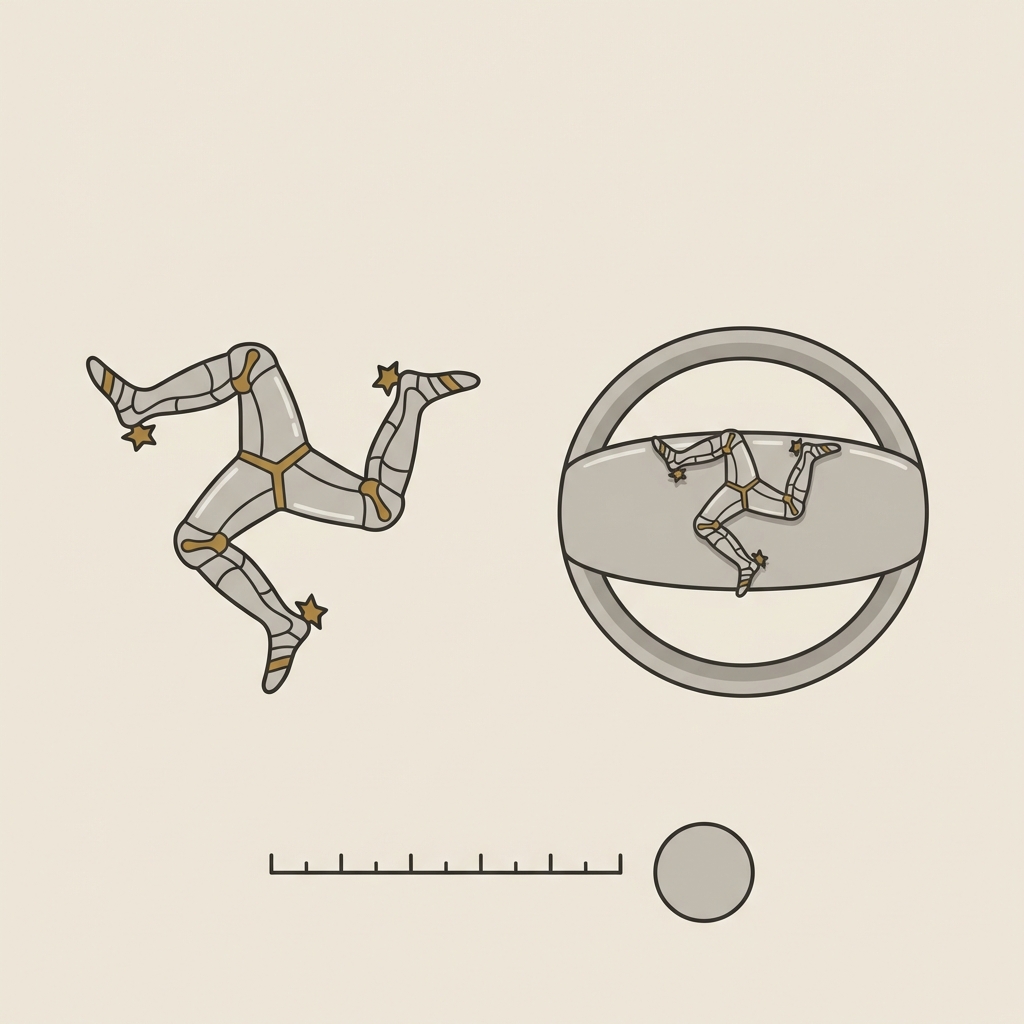
Collectors see two common visual families when people refer to triskelion or triskele motifs: the triple-spiral, a set of three connected spirals or volutes, and the three-legged device, a radial motif built of three bent legs or arms. The triple-spiral usually reads as a spiralling, curvilinear ornament while the three-legged form reads as a radial, often geometric emblem with clear limbs; describing the difference helps you search catalogues and reference pages. For a concise formal definition see Wikipedia.
Small additions that look decorative can change how a modern viewer experiences a motif. Added elements, such as central bosses, interlaced bands, or pointed tips, can tie a design to a particular workshop style or later heraldic practice, and matching those cues to published examples is an effective first step in identification. For comparison, the famous triple-spiral associated with the passage tombs is visually distinct from the Isle of Man three-legs emblem, which is an official heraldic device UNESCO Brú na Bóinne listing.
Triple spiral versus three-legged triskelion
The triple spiral typically uses smooth, flowing lines and often appears carved in stone or stamped on metal surfaces. The three-legged triskelion uses radial symmetry with three arms or legs that may be bent at the knee or joined to a central boss. Being able to say which of these families a ring belongs to will help you frame searches in museum catalogues and in seller communications, and you can compare images with the rings collection to refine search terms.
Regional stylizations and small decorative additions
Regional stylizations matter because workshops repeated local motifs according to taste and technique. A Mediterranean-inscribed triple spiral may be executed differently from an Atlantic seaboard example, and a later heraldic rendering will usually emphasize schematic clarity over organic curvature. When you describe a ring to a seller, include words like triple spiral, three-legged device, and any visible decorative additions to speed clear responses.
triskelion ring meaning: origins and early archaeological context
The earliest secure attestations of the triple-spiral motif come from Neolithic contexts, most notably carved stone art associated with passage tombs, where the symbol occurs among other curvilinear decorations; these early appearances place the motif within a very long visual history that predates classical and medieval interpretations Newgrange: Archaeology, Art and Landscape by M. J. O'Kelly.
The triskelion is not intrinsically bad; its meaning depends on historical origin, local usage, and whether a specific modern variant has been appropriated. Check provenance, civic heraldry, and monitoring resources before wearing or gifting.
Archaeological contexts give us dating and context but rarely a single, fixed symbolic translation. A spiral carved on a stone slab can indicate cosmological thought, movement, or an ornamental convention depending on context and associated finds; scholars therefore treat early material as evidence of use and meaning that layered over time, rather than as proof of one original interpretation Encyclopaedia Britannica entry on the triskelion.
When assessing a claimed Neolithic provenance for a ring, ask whether the seller links the piece to a documented find, publication, or collection history. Provenance that points to published material or to established collections strengthens an attribution; undocumented attributions that rely solely on visual resemblance should be treated with caution.
Neolithic attestations and Newgrange
Newgrange and related passage tomb art are commonly cited as foundational instances of the triple-spiral motif, and descriptions of those carvings are a useful comparative reference when you encounter spiralled rings attributed to early contexts. Using site-level publications or major catalogue entries helps avoid circular attributions where a modern label simply repeats a guess.
How early contexts inform but do not fix later meanings
Archaeological dating places motifs in time and place, which is essential for careful historical interpretation. However, later cultures repeatedly adapted similar threefold ideas for their own symbolic uses; recognizing that continuity does not equal sameness helps you avoid reading modern connotations back into ancient objects.
How different cultures and periods have read the motif
The threefold motif appears in many cultural contexts including Celtic, Greek, Roman, and medieval heraldic traditions, and specialists note diverse readings such as solar or cosmic metaphors, tripartite cosmologies, and decorative heraldry; this variety means a single interpretive frame rarely captures the full historical range Encyclopaedia Britannica entry on the triskelion.
Different workshops and periods favored distinct executions and meanings. For example, classical Mediterranean uses could emphasize geometric balance and civic identity, while Celtic contexts often placed spirals within complex interlace programmes. Recognizing the era and likely workshop helps narrow plausible readings without asserting certainty.
Celtic, Greek and Roman usages
In Celtic contexts the triple spiral figures in stone carving and metalwork and is often read in relation to cyclical or tripartite imagery. In Greek and Roman contexts related threefold motifs appear in coinage and decorative arts, where they may signal local heraldry or decorative convention rather than a single cohesive theology. For direct visual comparators see the Celtic rings collection.
Medieval heraldry and later decorative uses
By the medieval period, threefold devices could be formalized in coats of arms and civic marks. Heraldic versions favor clear, reproducible shapes and often carry assigned civic meanings. When a rings design resembles a heraldic device, it is worth checking official heraldry pages for a match.
Modern civic and heraldic uses that are official and non-controversial
Some modern civic emblems adopt three-armed devices in official, non-pejorative ways. The Isle of Man three-legs is a widely cited example that functions as an official heraldic emblem for that jurisdiction and is documented in government sources Isle of Man Government heraldry page.
Other civic and regional emblems similarly use threefold devices without hostile intent. When a rings motif resembles a documented civic mark, consult the issuing authoritys heraldry pages to confirm whether the resemblance is coincidental or indicates a deliberate emblematic link.
Follow @auroraantiqua for provenance and close-up studies
Consult seller documentation and the checklist sections in this article before deciding to wear or gift a ring; clear provenance and simple civic matches often resolve uncertainty.
Checking official emblem pages can also reveal protections or local expectations about use. Civic symbols may be subject to specific rules about reproduction, and understanding those practices helps you avoid inadvertent misunderstandings when wearing or displaying a ring with a familiar emblem.
Isle of Man three-legs and official heraldry
The Isle of Man example highlights how a threefold device can be fully civic and non-controversial. Official heraldry pages provide the authoritative description and use conditions for such emblems, which is why they are the right starting point when a motif resembles a known emblem.
When the motif becomes controversial: documented modern appropriation
Monitoring organizations and mainstream reporting document cases where variants of triskele-like motifs have been appropriated by extremist or fringe groups, and such documented contemporary uses can give some modern variants problematic associations; consult vetted monitoring sources to check whether a specific design is mentioned in reports Anti-Defamation League triskele overview. See also a regional entry at the Connecticut ADL for a related summary Connecticut ADL triskele entry.
Media and cultural analysis show that meanings can shift when a public group repeatedly uses an ancient-looking design for modern purposes. That process of symbolic change is not unique to the triskelion and is part of broader patterns in which graphics can be reassigned new political content over time BBC analysis on how symbols change meaning.
What monitoring organizations report
Extremism-monitoring organizations document that some specific graphic variants have appeared in modern extremist contexts. Those reports typically identify a small set of stylizations and usage patterns rather than condemning the ancient motif in all its historic forms.
How media and scholarship cover symbol change
Scholarly and journalistic treatments emphasise the mechanisms by which symbols acquire new connotations, including repetition in public settings, association with specific groups, and simplification or stylization that separates a modern graphic from its historical precedents.
How to assess a triskelion ring before wearing or buying
Start with three practical questions you can ask a seller: 1) What provenance or collection history accompanies the ring, 2) Are there published references or catalogue entries, and 3) Do condition and restoration notes indicate any intrusive repairs that change the motifs appearance. Asking these questions helps you move beyond surface resemblance and towards documented context Isle of Man Government heraldry page.
Quick visual checks include confirming whether the motif is a triple spiral or a three-legged device, noting any asymmetry or modern tooling marks, and comparing the ring to images in authoritative reference works and civic pages. If a seller cannot provide clear photos or measurements, request them before making a decision.

If documentation is sparse, ask for time-stamped images or for references to published comparanda. When provenance is vague or absent, assume higher uncertainty and consider whether you are comfortable bearing that risk if you plan to wear or publicly display the piece.
Three practical questions to ask a seller
Ask for collection history, any prior ownership notes, and verification letters if available. Explicit references to publications or museum catalogues are especially helpful because they allow independent confirmation. Sellers who can provide condition notes and transparent restoration descriptions make it easier to judge whether the motif is original or later altered.
Quick visual and documentation checks
When you review images, look for tool marks, patina consistent with age, and whether any decorative elements appear to have been modernly retooled. Clear, high-resolution images of the bezel, hoop, shoulders, and the interior of the ring should accompany any serious listing.

A decision framework: is this specific triskelion design appropriate for you?
Step 1: identify visual type and likely source. Decide whether the ring is a triple spiral, a three-legged device, or a later decorative adaptation. Use that identification to choose which reference pages you consult next.
Step 2: check documentation and civic usage. Look for provenance records and compare the motif to official heraldry or civic emblem pages. If the design closely matches a current civic emblem, research that emblems official guidance before buying.
Step 3: assess contemporary associations and personal comfort. Consult monitoring organizations for any reported appropriation of visually similar motifs, then weigh whether you are comfortable wearing or gifting the design in your social context. A conservative choice is reasonable when the rings modern visual language strongly resembles a documented contested variant Anti-Defamation League triskele overview.
Step 1: identify visual type and source
Be literal in your description: triple spiral, three-legged triskelion, or modern stylization. Use those terms in queries to museum catalogues and in written communications with sellers so replies are precise and comparable.
Step 2: check documentation and civic usage
Official civic pages and heraldry registers are the right place to confirm emblem matches. If there is a close match, check local usage rules and consider how visible display might be perceived by people familiar with that emblem.
Step 3: assess contemporary associations and personal comfort
Decide whether you will wear the ring in settings where its graphic might be noticed by people with strong reactions. If you plan to gift the piece, consider the recipients context and whether a conservative choice is more considerate.
Common mistakes and pitfalls collectors make with triskele designs
A common error is assuming every threefold motif shares the same meaning across time and place. Because the motif appears across cultures and centuries, treating it as a single symbol can lead to overconfident attributions and miscommunication with buyers or with a wider audience Encyclopaedia Britannica entry on the triskelion.
Another pitfall is relying solely on visual resemblance without documentation. Visual similarities are helpful for initial research but are insufficient evidence for firm historical claims; provenance, publication references, and condition notes are necessary to support stronger claims about origin or meaning.
Assuming every threefold motif has the same meaning
Do not project modern interpretations directly onto ancient objects. An ancient triple spiral carved into stone may have had a local meaning that is not traceable to later ritual or civic uses.
Relying solely on visual resemblance without documentation
When provenance is absent, be transparent about uncertainty and avoid definitive labels in listings or in public descriptions. Use phrases like appears to be or described as when discussing materials and attributions.
Practical research steps: sources to consult for a specific design
Begin with general reference entries to understand broad histories and common typologies; an encyclopedic entry gives a reliable overview to frame further searches Encyclopaedia Britannica entry on the triskelion.
Next, consult site or collection level resources when an object is claimed to come from a specific context, for example site listings and catalogue entries for major archaeological sites provide essential context; use those pages to confirm whether a claimed origin is plausible UNESCO Brú na Bóinne listing.
Finally, check official heraldry pages for civic matches and reputable monitoring databases for any reported modern appropriation. Combining these sources gives a balanced set of checks you can complete before purchase or display Anti-Defamation League triskele overview.
Authoritative references: encyclopedias and museum pages
Use trusted encyclopedias for general context and museum pages or published catalogues for object-level comparisons. Museum records often include measurements, materials, and catalogue references that are essential for confident identification.
Monitoring resources: heraldry pages and hate-symbol databases
Official government heraldry pages can confirm civic emblem matches, and vetted monitoring resources record modern patterns of appropriation. Use both to distinguish benign civic usage from contested contemporary adaptations.
Short case studies: Newgrange triple spiral, Isle of Man three legs, and a contested modern variant
Newgrange offers a clear early instance of the triple-spiral motif in a Neolithic context and is a useful reference when comparing triple spirals attributed to early contexts; published archaeological work frames those designs as open to multiple interpretations rather than as evidence of a single symbolic meaning Newgrange: Archaeology, Art and Landscape by M. J. O'Kelly.
The Isle of Man three-legs illustrates an official heraldic use that is civic and non-controversial; the devices status is documented on government heraldry pages and functions as a local emblem rather than as a contested graphic Isle of Man Government heraldry page.
Contested modern variants typically appear in monitoring reports when a simplified or stylized threefold mark is repeatedly used by contemporary groups; those reports identify graphic patterns and contexts rather than condemning the ancient motif itself, which remains historically layered Anti-Defamation League triskele overview.
Newgrange: archaeological context and symbolic openness
The Newgrange triple spiral is best read as part of a broader decorative programme in passage tomb art, with scholars emphasizing interpretive openness. Use site publications and specialist catalogues when an attribution to Newgrange is proposed.
Isle of Man: official heraldic usage
The Isle of Man three-legs is widely used in civic contexts and has a documented heraldic history; this makes it a good comparator when a ring resembles a public emblem rather than an ancient pagan motif.
A documented contested modern usage and how to spot differences
Contested modern usages usually show simplified, high-contrast graphics used repeatedly by a known group, often without provenance that ties the mark to older material culture. When such patterns are reported, monitoring resources typically include images and context notes to aid identification.
How sellers and catalogues should document triskelion rings
Sellers should provide clear provenance elements when available: collection history, prior ownership notes, and any verification letters or catalogue references. Transparent provenance language helps buyers check claims against published sources and to evaluate the strength of an attribution.
Condition and restoration notes should state what was stabilized, what was repaired, and what was left untouched. Precise language about restoration helps researchers and buyers understand whether the motif has been altered by modern interventions and whether visual features are original or later additions Isle of Man Government heraldry page.
What to expect in provenance and condition notes
Expect measurements, clear photographs, a description of materials, and a brief provenance paragraph. When restoration notes exist, they should indicate materials used and who performed the work if that information is available.
How restoration and attribution should be described
Restoration entries should be factual and limited to what was done, avoiding value judgements. Attribution language is best framed in conditional terms, using phrases like appears to be or described as to reflect uncertainty when direct evidence is limited.
A short checklist before wearing, gifting, or publicly displaying a triskelion ring
Immediate checks you can do in minutes: visually identify triple spiral versus three-legged device, look for modern tooling marks, and request provenance notes or catalogue references. These quick steps often resolve obvious mismatches or missing documentation.
When to pause and do deeper research: if the motif closely matches a civic emblem or if monitoring resources list a visually similar graphic. In those cases, pause and cross-check official heraldry pages and vetted monitoring databases before wearing or gifting.
Immediate checks you can do in minutes
Ask for close-ups of the bezel and hoop, clear interior photos, and an explicit statement of provenance. Basic condition notes and a statement about any restoration are reasonable requests before purchase.
When to pause and do deeper research
Pause when the seller cannot provide clear provenance or when images suggest modern reworking. If the rings contemporary visual language resembles a reported contested variant, do not display it publicly until you are comfortable with the contextual evidence.
Conclusion: a balanced view and next steps for curious collectors
The evidence supports a balanced conclusion: the triskele or triskelion is an ancient, multi-context motif and is not intrinsically bad, but documented modern appropriation means specific variants can carry problematic associations in contemporary settings Encyclopaedia Britannica entry on the triskelion.
Next steps: use the decision framework and printable checklist in this article, consult the listed sources for confirmation when a design is claimed to be civic or archaeological, and prioritise transparent documentation when buying. If you want further help, consult authoritative reference entries and monitoring databases before making a public display or a gift decision Anti-Defamation League triskele overview.
Visually, the triple spiral uses flowing spirals joined at a centre, while the three-legged triskelion has three radial limbs or bent legs. Use close-up photos and simple descriptive terms when asking sellers or searching catalogues.
Not automatically. Check the issuing authorities heraldry pages for guidance and consider local etiquette; if in doubt, prioritize documented civic usage and consider a conservative choice for public display.
Request provenance or collection history, high-resolution images, clear condition and restoration notes, and any catalogue or publication references that support an attribution.
References
- https://www.britannica.com/art/triskelion
- https://www.adl.org/resources/hate-symbols/triskele
- https://whc.unesco.org/en/list/659
- https://thamesandhudson.com/newgrange-9780500274240
- https://auroraantiqua.store/collections/rings
- https://en.wikipedia.org/wiki/Triskelion
- https://auroraantiqua.store/collections/celtic-rings
- https://auroraantiqua.store/collections/ancient-roman-rings
- https://www.gov.im/about-the-government/history-and-heritage/isle-of-man-symbols/
- https://connecticut.adl.org/resources/hate-symbol/triskele
- https://www.bbc.com/culture/article/20140314-when-symbols-change-meaning
- https://auroraantiqua.store/products/the-celestia