


What a vintage egyptian ring is and why dating matters
Definition and scope
A vintage egyptian ring typically refers to an ancient or historically styled ring with Egyptian motifs or origins that can indicate use in antiquity or later historic periods; in many cases a piece described this way may be an ancient ring, a later historic piece inspired by Egyptian motifs, or a modern reproduction, and careful assessment can indicate which category is most likely.
Visual style and iconography remain effective first line clues for placing a ring within a broad period, because bezel shape, intaglio type and motif can reflect workshop habits of a time and place; for practical museum guidance on using style as a dating tool see the Metropolitan Museum of Art resources on jewellery in the ancient world Metropolitan Museum of Art.
Why approximate dating matters for collectors
For collectors, an approximate date helps set realistic expectations for condition notes, conservation needs and provenance research without implying value guarantees; knowing whether a ring is likely ancient, medieval or a later revival informs how it should be handled and conserved.
When documenting a piece, use conditional language such as can indicate or likely rather than absolute statements, and record the evidence used to reach an estimate so future reviewers can reassess the attribution.
Responsible language and limits of visual dating
Visual dating can narrow possibilities but has limits: motifs and shapes are useful to place an object broadly, yet repairs, later mounts or deliberate historicizing styles can imitate older forms and mislead a visual assessment; museum guidance warns that style alone rarely produces a single year date and is best used alongside other evidence V&A guidance on dating jewellery.
When a claim depends on precise manufacturing dates or assay evidence, seek documentary or scientific corroboration before presenting a firm year for the ring.
The four evidence streams to date a vintage egyptian ring
Overview of the four streams
Collectors and curators use four complementary streams to estimate age: visual style and iconography, hallmarks and assay date letters where present, construction and setting techniques, and non destructive materials analysis; combining these streams reduces systematic error and produces a more defensible estimate.
Start with what you already have: good photographs and any paperwork, then move through the streams in order of likely yield for your case - style first for quick narrowing, hallmarks for precise manufacture dates when present, construction cues to refine period, and testing for materials confirmation.
How they interact and which are most decisive
Hallmarks, where they exist, frequently give the most precise manufactured date and can reduce uncertainty dramatically, but they are only useful in objects from hallmarked jurisdictions or later periods; for an explanation of hallmark reading and assay office resources see professional hallmark guides Goldsmiths' Company hallmarking guidance.
Non destructive testing such as portable XRF can corroborate stylistic suggestions by identifying alloy markers consistent with particular eras, and modern conservation literature outlines these methods and their appropriate uses Journal of Archaeological Science: Reports on portable XRF, and see Thermo Fisher's overview of XRF.
printable checklist to follow the four evidence streams
Use with clear photos
Provenance and auction records can be decisive and should be sought early; catalogue entries or prior lot records frequently supply documentary dating that outweighs a single stylistic clue Christie’s Education on auction dating.
Combining independent clues is the recommended workflow because repairs or forgeries may mimic period features; if independent streams disagree, consider a specialist appraisal to resolve the conflict.
A step by step workflow to date a vintage egyptian ring
Prepare and document the object
Begin by photographing the ring from multiple angles: full profile, bezel close up, inside the hoop, shoulders and any marks, using a plain neutral background and scale; good images are the basis for remote second opinions and future reference.
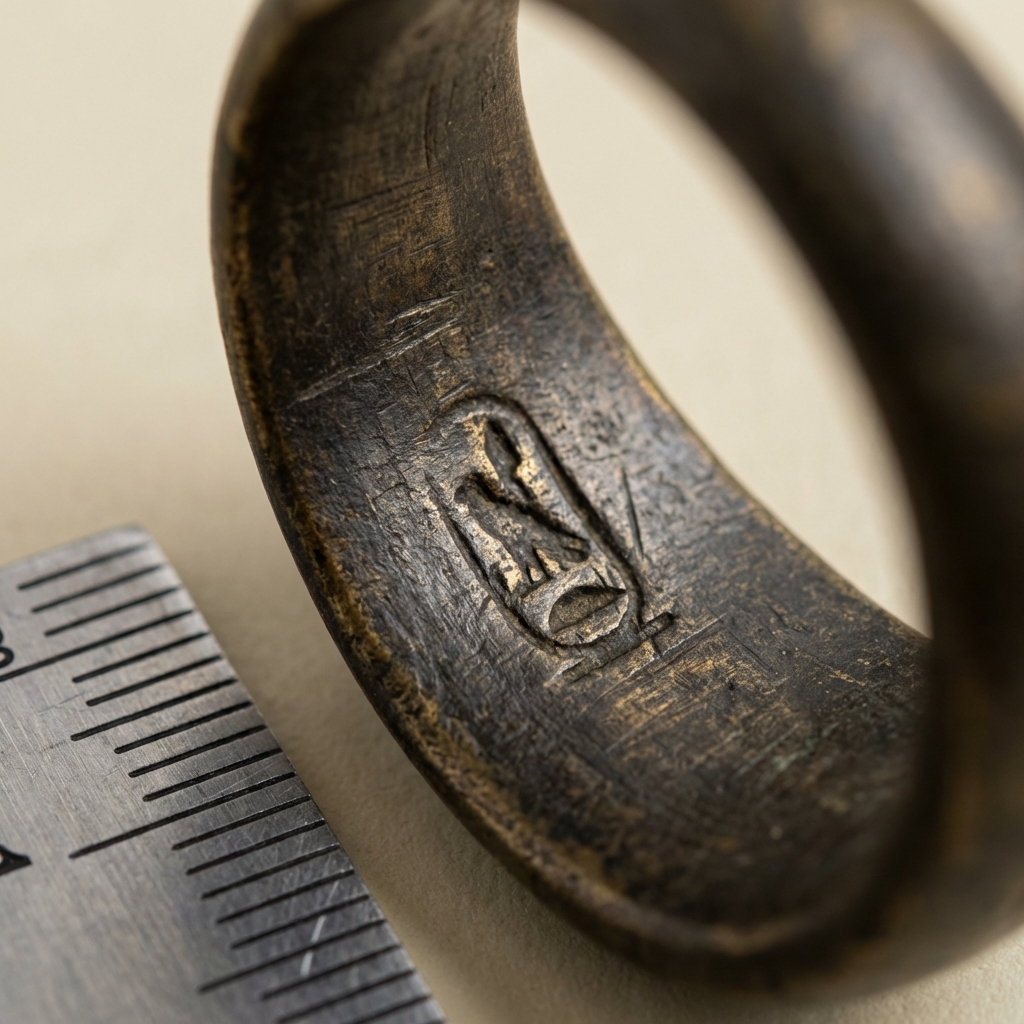
Record measurements- inner diameter in millimetres, hoop thickness, bezel depth and any visible weight- and enter them into condition notes or a worksheet so you can compare against catalogued examples.
Visual survey checklist
Run a consistent visual survey: note motif or iconography, bezel shape, intaglio style if present, surface patina, and areas where solder or joins are visible; these observations help you place the ring with comparative material published by museums and specialist guides Metropolitan Museum of Art and see similar examples in our ancient Roman rings collection.
Keep brief restoration notes: describe any visible repairs, modern solder, replaced stones or later settings, and whether wear appears consistent with long term use; clear restoration notes help later specialists separate original manufacture features from interventions.
How to escalate to tests or specialist appraisal
If hallmarks are absent or ambiguous, and the visual survey leaves a broad range, request non destructive materials testing such as a portable XRF scan to check alloy composition; these tests often confirm or contradict stylistic estimates and are widely recommended in conservation practice portable XRF literature and see the VRXRF guide.
When results remain unclear or the object has potential legal or high value implications, seek a formal appraisal from a qualified conservator or conservation scientist who can provide a written laboratory report or condition letter to support provenance claims.
How to read hallmarks and assay date letters on rings
Where hallmarks typically appear on rings
Hallmarks and maker marks commonly appear inside the hoop or on the shoulders of later rings, and photographing them with magnification and raking light improves legibility for comparison with official tables.
Photograph marks using a macro lens or a phone with a macro attachment; include a scale and rotate the image so letters or symbols are clearly upright before consulting hallmark tables.
Common hallmark systems and reading date letters
In jurisdictions with formal hallmarking systems, assay office date letters and town marks can often narrow a ring to a single assay cycle, making them the most precise manufactured date evidence where they exist Goldsmiths' Company hallmarking guidance.
Use official assay office resources to compare letters and symbols, and if a mark is partially worn, document the ambiguity and seek an expert transcription rather than guessing a letter from a low quality photo.
Limits and pitfalls when marks are worn or foreign
Marks can be altered, re punched or misleading when rings circulate across borders; worn marks, foreign marks and added marks from later repairs complicate interpretation and require cautious handling of any precise date claim Christie’s Education on provenance and marks.
Practical photographing tips: use a neutral background, steady the ring, take several images at different angles, and label each image with the date and camera settings to preserve a clear chain of documentation for future reviewers.
Behind the scenes on @auroraantiqua
Save this guide or contact a conservator for help with photographs and mark transcription.
Construction, setting and gemstone clues collectors should check
Solder and join types to note
Inspect solder seams and joins for evidence of historic technique: visible seam solder, lumped solder or modern seamless laser work each point to different eras and workshop practices, and these features are commonly used by gemological labs to refine dates GIA guidance on antique jewellery cues.
Note whether joins appear to be contemporary with surrounding wear; a modern solder with bright metal at the seam suggests a later repair or remount rather than original manufacture.
Bezel, hoop and shoulders-what to inspect
Bezel shape and how the bezel attaches to the hoop offer strong period clues: plain, thick bezels with intaglios are common in ancient rings, while thinner, machine trimmed bezels point to later workshops; museum studies examine these typologies as consistent markers for dating Metropolitan Museum of Art.
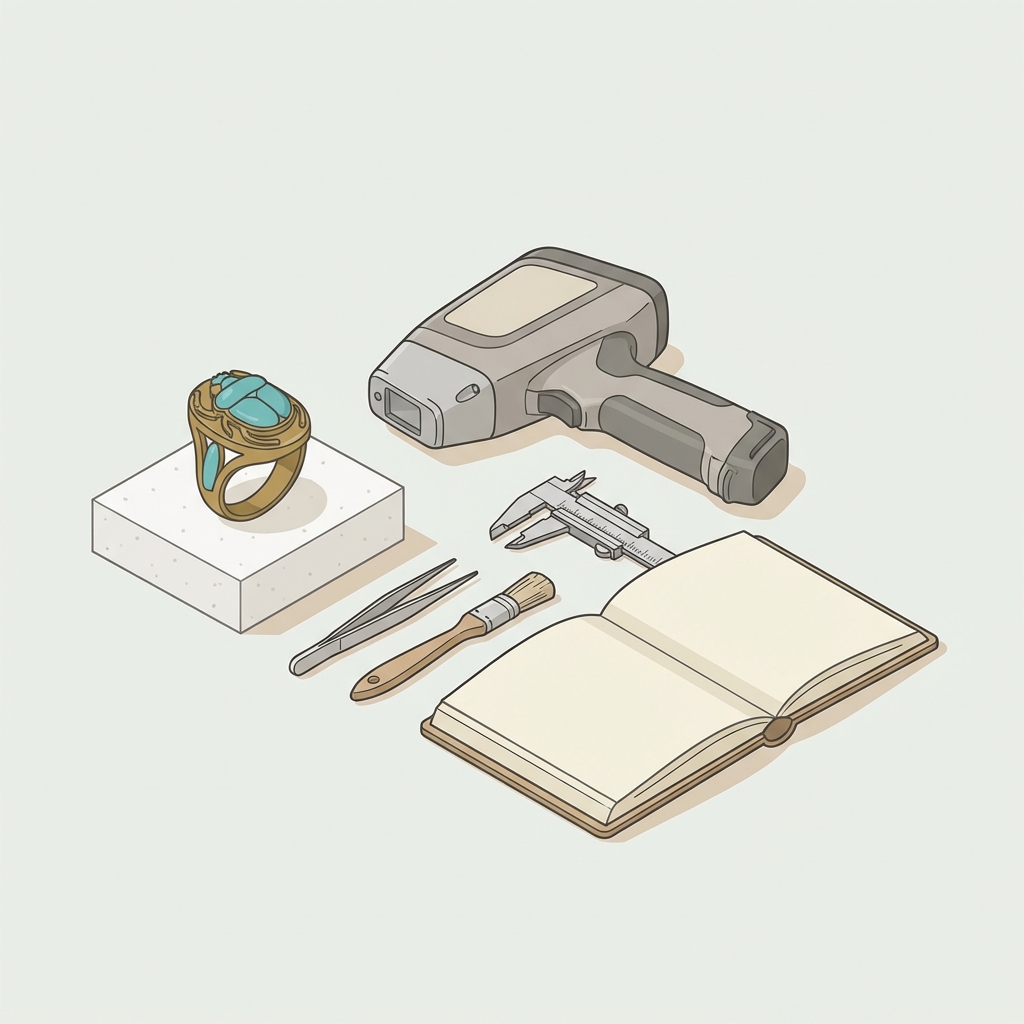
Record these observations in condition notes and restoration notes so future evaluators can see which features were original and which were altered.
Stone cutting profiles and intaglio styles
Stone cutting profiles and intaglio technique are revealing: certain cuts, like cylinder drills or cameo carving styles, map to known periods and workshops and are used by conservators to refine stylistic dating GIA on stone cutting and intaglio.
When a stone appears to be replaced, note its mounting type and whether its wear matches the surrounding metal; mismatched wear often signals a later replacement or restoration.
Non destructive materials analysis explained for collectors
What portable XRF and surface microscopy reveal
Portable XRF can identify alloy composition and element markers such as silver purity, copper content or trace elements that support or contradict a stylistic estimate, and conservation practice increasingly recommends these non destructive scans as part of responsible analysis Journal of Archaeological Science: Reports on portable XRF and see practical guidance on maximizing pXRF accuracy.
Surface microscopy clarifies corrosion patterns and tool marks that are not visible to the naked eye and can indicate machining marks or hand finishing consistent with particular periods.
How results corroborate or contradict stylistic dating
An alloy composition inconsistent with expected materials for a proposed period can prompt a revised assessment, while a matching alloy strengthens the stylistic case; because surface enrichment or corrosion can bias results, interpret XRF output with a conservation scientist or lab report rather than alone.
Understand limits: XRF reads the surface layer and can be affected by corrosion or plating, so professional interpretation matters and results should be reported in a formal lab note when they influence a public attribution Metropolitan Museum of Art on conservation context.
Use a structured workflow that records photographs and measurements, surveys style and construction, checks for hallmarks, searches provenance records, and, when needed, commissions non destructive materials testing or a specialist appraisal to resolve discrepancies.
When to ask for a lab report: if alloy results would change sale, export or legal status, or if different evidence streams disagree, commission a qualified conservation lab with published methods and a written report.
Provenance, auction records and documentation best practices
What counts as useful provenance
Useful provenance includes dated catalogue entries, prior auction records, collection histories and any verification letters; these documentary items often supply decisive dating evidence and should be treated as primary sources when available Christie’s Education on provenance.
Record the chain of custody for any documentation and note whether an item was described by an auction cataloguer or by a private owner so readers can weigh the authority of the source.
How to save and cite auction or catalogue records
Save images and PDFs of catalogue pages, lot descriptions and condition reports; include the auction house name, lot number, sale date and a screenshot of the listing to preserve context for later reference.
When citing provenance in your notes, be transparent about uncertainty: quote catalogue descriptions directly and attribute the description to its original source rather than paraphrasing in a way that may imply certainty.
How provenance can change an age estimate
A documented auction or catalogue entry that assigns a firm date or links a ring to a known collection can override an uncertain visual estimate and should be prioritized when judging final attribution Christie’s Education.
When provenance conflicts with physical evidence, treat both streams as informative: list the conflict clearly in condition notes and seek further tests or specialist review if the discrepancy matters for sale, export or legal status.
Common pitfalls, quick case examples and next steps
Typical errors and how to avoid them
Common mistakes include mistaking later repairs or re mounts for original features, over relying on a single stylistic clue, or misreading a worn hallmark; avoid these by using multiple evidence streams and documenting uncertainties in condition and restoration notes V&A guidance.
Keep a conservative public description: note a likely date range and list the reasons for that estimate rather than presenting a single definitive year when evidence is mixed.
Short anonymized case examples showing the workflow
Case 1: a band with Egyptian iconography and a thick ancient style bezel was tentatively dated to antiquity by style; XRF confirmed a silver alloy consistent with ancient usage and a catalogue entry from a private collection supported the attribution, illustrating how combined streams produce confidence.
Case 2: a ring with convincing Egyptian motifs but modern machine solder and a replaced stone was reclassified as a 19th century revival after construction observations and hallmark absence were considered together, showing how construction details can overturn a surface impression.

Clear next steps and contact points for specialist help
Before buying or attributing a piece, follow this checklist: document photos and measurements, run the visual survey, check for hallmarks, record construction notes, seek provenance documents, and only then consider non destructive testing or formal appraisal if needed, or browse our rings collection.
If you need help with photographs, mark transcription or locating a conservation lab, consider contacting a qualified conservator or a curator experienced with ancient rings for a written opinion or use our contact page.
A non specialist can often narrow a ring to a broad period using style, construction and visible marks, but precise dating usually requires hallmarks or scientific testing and may need a specialist appraisal.
Yes, portable XRF is non destructive and generally safe when performed by qualified technicians; results are best interpreted by a conservation scientist or lab.
Document the conflict clearly, save all records, and seek a specialist appraisal or lab report to reconcile the discrepancy before making public claims.